
Featured
Eliades Ochoa: The Art of the Storyteller and the Making of History


It is a proverbial Act of God that the musician Eliades Ochoa should come from Santiago de Cuba. That, after all is where the seed of Cuba’s music tree was sown hundreds of years ago…
…and that is where it grew and bred the greatest trovadores: José “Pepe” Sánchez, Antonio Gumersindo “Sindo” Garay García, José “Chicho” Ibáñez, Rosendo Ruíz, Manuel Corona and Alberto Villalón, all six responsible for the roots and branches of the Cuba’s trova music tree. For from that seed the whole process of life itself began and, after paying the dues it came perfect time for harvest; then, not just a tree, but an artist, was seemingly grown like an axiomatic branch from the ground up. His or her blood was made of sap that bore the poetics of music from his or her heart, through the soul and out of the lips, where—moulded by each one’s peculiar living breath the lyric was formed. Another river of sap and blood flowed through the arteries and veins and on to the arms, hands and out through the fingers that played a something like a “tiple”; an eight-stringed cross between a “tres” and a Spanish guitar. But that is simply not enough for music to be made.
First the trovador must make up songs of his own composition, of others, but of the same kind, meaning songs of “the others own composition” as well. He must always accompany himself on the guitar, or the tres or in the case of many musicians recently, on that peculiar, “eight-stringed tiple”. Then there is the matter of the poetics of the song. Its lyrics must be bred of poetry. The hard and soft accentuated prosody must bump and grind, jump and flutter and wing itself as if flying out of the lips of a bard. The music of the tres or the guitar or the tiple must do likewise and make of the song a poem that will take the breath away. It was and is out of this tradition that the trovador was and continues to be born. It was the same of Sánchez, Garay, Ibáñez, Ruíz, Corona and Villalón, and members of their tribe that the music was begotten and continued to be.

The eventual migration to Havana and the formation of that members’ only club, The Buena Vista Social Club, by men like Máximo Francisco Repilado Muñoz “Compay Segundo” is a part of that history as was the eventual migration of one of the club’s youngest members, so to speak: Eliades Ochoa. This youngest trovador also made songs of his own composition and played those compositions of Ibrahim Ferrer, Compay Segundo and Sindo Garay and Pepe Sánchez and others of the legendary tree on his magnificent instrument, a collision of tres and guitar. He was equally a bard and a teller of stories of history—a griot in the Afro-Caribbean music tradition. And he made it eventually to the Buena Vista Social Club in Havana. Their music was son and danzón, bolero and guajira and merengue. There and with this Ry Cooder met him with Ferrer and Segundo, Rubén González and Omara Portuondo and the others, when he made that legendary recording—fifty years after the club was born—with Juan de Marcos González. And when the legend spread with that fabled Carnegie Hall Concert and the Wim Wenders film and the Carnegie-made documentary, a new legend was born and the musicians of Buena Vista Social Club began to be sought by the cognoscenti and by simple fans alike in venues across the world.
This is what brought Eliades Ochoa to the Danforth Music Hall, a venue so apt for the music of son and danzón that it felt like they were playing to members of a sort of foreign Buena Vista Social Club, especially when the musicians exhorted the audience to stand up and dance with them and to their music. No one could resist or refuse for such was the hypnotic fire of the music of trumpet and conga, tres and maracas that it had to be done according to their word. And it was not just apt, but spectacularly unique—an experience never to be forgotten. Not only was that because Ochoa was who he was and a performer of the highest order, but also because of who accompanied him as well. The musicians had to be a part of his Cuban retinue. He could never have made it with a house band. This was Buena Vista Social Club revisited and the audience—every man woman and child—was members only. Of course that was not the way it was in the 30s and 40s with Garay and Corona and Ruíz. Then it was a matter of the men enjoying history with cigars and “certain women”. Then it was a matter of understanding the times they were in and the ills of Fulgencio Batista.

But the revolution was brewing not only in politics; it was a question of inevitable change in the Art of telling a story as much as it was in the matter of history and that was, in itself the making of Cuban music history. And so this night in 2012, the trovador, resident in the Danforth Music Hall, but for a fleeting two hours, not only tells stories of his own composition and those like ones of others making, he remakes history with this art of Cuban son and danzón and merengue and guajira. Most of the audience, had, hitherto lived vicariously, through Wenders’ film and through Cooder’s and Gonzalez’ recording.
But now is the time of reckoning and the audience is melded to the hip of Ochoa and his ensemble. The musicians are blazing a new trail in the art. Trumpeters, Alain Antonio Dragonit Cotorruello and Lenis Lara Castellanos are on fire. Theirs is a molten mix of volvic splendour that is being poured out in short bursts; spurting upwards it seems from Ochoa’s vortex of energy. Pianist Marcos Antonio Fernandez Lopez is keeping the harmonic content at the highest level. He would have been better served by a 7’ Steinway Grand, but tonight the music is much too loud and only a relatively miniature version of any grand piano will do as long as the mood is ebullient and the joy loud and palpable. Fernandez Lopez is joined in the art of tonal coloration by guitarist Osnel Odit Bavastro, a large and voluble presence throughout the concert. The guitarist wears an eternal smile, barks and hoots occasionally into the microphone, adding colourful accents to the lyrics of Ochoa. He counts down most of the music and the tone of his guitar is remarkable. A middle register tenor guitar this silhouette guitar appears to be made of one flowing line from body to fret and sounds just like that long flowing line throughout the concert.

Missing from the instrumental collection was the large presence of the acoustic bass, but that was cleverly substituted by a 5-string electric bass that was superbly tuned and although the memorable textures of the acoustic bass is sorely missed, the work of José Angel Martínez Nieves is noteworthy. He is a rhythmic rock and a sublime melodist when he is called upon to be one. His solo on the opening chart played by Eliades Ochoa sets the tempo and high standard of his play throughout the night. He is magnificently supported by the percussion colourist, Jorge Maturell Romero and the magnificent Eglis Ochoa on maracas and vocals. The other Ochoa is also a magnet for musical ideas and although he plays a deeply humble role of reflecting the poetry of the elder Ochoa, it is impossible to ignore him. Eglis Ochoa keeps a steady and subtly shaded rhythm on the maracas as he sings in harmony with guitarist Odit Bavastro and it is off their energy that the legendary Eliades Ochoa feeds.
The leader is magnificent throughout the first set; as tight as the rest of the ensemble is. He is gracious throughout the repertoire that he brings to the Danforth this night. And he is magnificent as well. Ochoa’s voice is razor sharp. His intonation is deep and resonant. He sallies forth from one song to the next. The lyric element of each is soaring not just from his lips but from the world of Santiago de Cuba, to all over the world. His version of “Pintate los labios Maria” is as exquisite as the history making story of the character is elevating. Ochoa shapes the son as he might have the body of a woman: sensually and with vivid lines that issue likes sparks from his wanton heart. On the magnificent rendition of “Estoy Como Nunca” he exhorts his singers and musicians to an urgency that makes the heart beat faster. Here the short and longer lines of the song collide and entwine to bring the narrative towards its glorious fruition.

The shorter, staccato lyric elements of “Arrimate pa’ca” drive Ochoa and his ensemble to punctuate each chorus with hearty palmas. It is here, also that his spectacular story-telling abilities come to a head as they reach another realm of perfection. His stratospheric bursts on the tres/guitar take this song, as it does every other one to another level. Ochoa’s soli are brief and only serve to accentuate the dramaturgy of the lyrics. But each one is succinct, presented and alive through hard slams of the root notes of the chord followed by harmonic invention of the highest order. In fact, it is almost impossible to separate the genius of Ochoa as a tresor and a vocalist. Both elements of this great musician combine to tell a story like no other musician. And it is easy to see, as his list of songs unfolds, how the Buena Vista Social Club has given rise to the monumental son, salsa and the rest of the Afro-Cuban music tradition that is now alive in Florida.
Perhaps no Eliades Ochoa concert would be complete without the great songs of the Buena Vista Social Club. This has to take the form of Compay Segundo’s classic, “Chan-Chan” a song so legendary and so rhythmically intense that it grabs the hearts of all present and forces participation from the very soul of every soul in the house. Ochoa offered his own twist to this legendary son as he did to the equally great compositions “El Carretero” and “Candela”. With his rumbling “R”s and his sliding “S”s Ochoa brings the music of these legendary charts to life in just the same manner as Segundo and his compatriots do in the Wenders film and as they did at the two concerts in Havana and at the Carnegie in New York.

However, it is not only Ochoa who brings the music to life. It is also his ensemble, meaning particularly the two musicians positioned at the extremities of the stage: The great maracas player and vocalist, Eglis Ochoa and the Music Director of the night, Osnel Odit Bavastro. Both of these men were spectacular, especially when the former performed his maracas solo and the latter wove his ample body into a mesmerising dance. This and the conga and bongo solo by Jorge Maturell Romero in the penultimate song of the recital capped off a performance to remember. But at the end of the day it was a magnificent concert that was led by the great Ochoa that made for a memorable night.
The brief introductory opening of Toronto’s own Laura Fernández’ stellar showing and her brilliant guitarist-accompanist Noah Zacharin was most apt. Surprisingly the audience was gracious and patient throughout her performance. In concerts past when a member of the Buena Vista Social Club has performed things might have turned out rather differently. However, Toronto audiences being what they are, Fernández was given a fair listen and she did not disappoint this eager audience either. She proved in his very own and unique way that she is a sensually original voice and a fine pianist as well. Playing songs from her reasonably successful independently produced debut album, Un Solo Beso Fernández set a sultry mood before she made way for the main event, the Grammy-award-winning Eliades Ochoa and his 8-piece Cuban band. Ochoa, for his part, established the legendary existential reality of not only the Buena Vista Social Club and its other surviving members—Manuel “Guajiro” Mirabal, “laud” player, Barbarito Torres and the great trombonist, Jesus “Aguaje” Ramos and the great chanteuse Omara Portuondo… Eliades Ochoa also proved that in the Art of Music there is also the Making of History over and over again.
* Eliades Ochoa performed a sold out concert in Toronto on Saturday, November 3, 2012 at the Danforth Music Hall.
Photographs by Robert Saxe [click on thumbnails to enlarge]


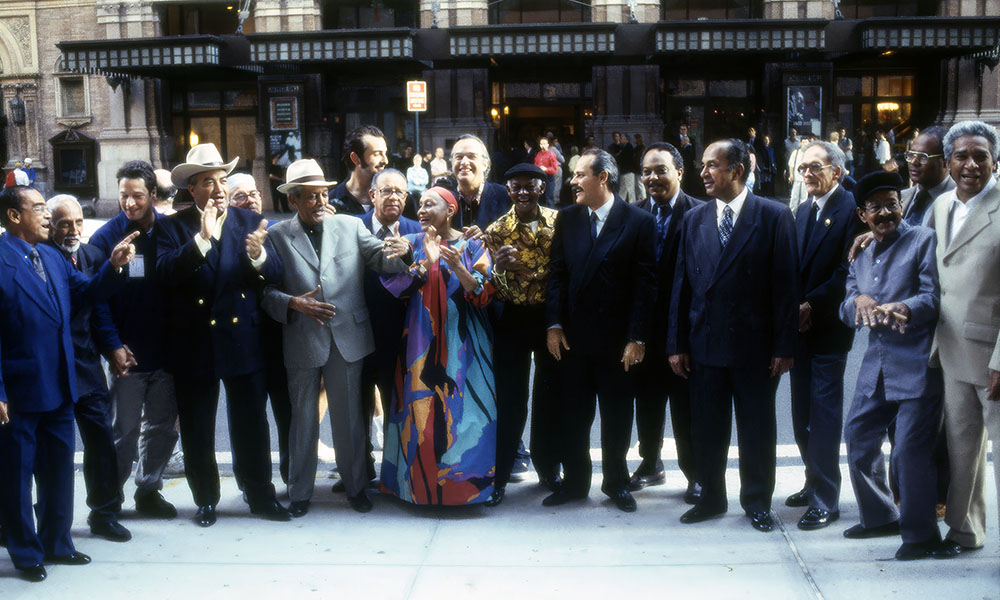
On March 26, 1996, inside the wood-panelled EGREM/Areito studios in Centro Habana, a group of musicians gathered without knowing they were about to make one of the most consequential recordings in modern Cuban music. The repertoire reached deep into son, bolero, danzón and canción, and behind every note stood decades of experience.
Cuban bandleader Juan de Marcos González, American guitarist and producer Ry Cooder, and British producer and World Circuit co-founder Nick Gold brought together veterans including Ibrahim Ferrer, Eliades Ochoa, Compay Segundo, Rubén González and Omara Portuondo. Over seven extraordinary days, they recorded Buena Vista Social Club, an album whose intimacy would eventually travel around the world.
Thirty years later, the record has sold more than eight million copies, inspired Wim Wenders’ Oscar-nominated documentary, returned Cuban masters to international prominence and found new life on Broadway. Now World Circuit Records marks the anniversary with a “Pearl Sunrise” double-LP edition that brings the story back to where it began: musicians sharing a room.

The Magic of EGREM Studios and the Havana Sessions
The Buena Vista story has always carried the aura of chance. Gold’s original Havana project envisioned a collaboration between Cuban and West African musicians. When the African participants were unable to make the journey, attention shifted toward the extraordinary musicians already available in Cuba.
What followed was not so much the “discovery” of unknown artists as the international reintroduction of musicians with deep histories of their own. Compay Segundo had spent decades within the son tradition. Rubén González was one of Cuba’s most distinctive pianists. Omara Portuondo was already a major singer. Eliades Ochoa brought the rural pulse of eastern Cuba, while Ibrahim Ferrer emerged as one of the project’s defining voices.
The EGREM room became part of the album’s character. Large, resonant and wood-panelled, it allowed the ensemble to record largely as a live unit, preserving the responsive quality of musicians hearing one another and shaping the performance collectively. World Circuit credits that environment with playing a major role in the final recordings’ singular sound.
That atmosphere is audible throughout. González’s piano converses with singers and rhythm section; Orlando “Cachaíto” López gives the music its supple bass foundation; Compay Segundo carries both pulse and memory; Ferrer turns a lyric into intimate speech. Cooder’s role was most effective when unobtrusive, helping create conditions in which the musicians’ individual personalities remained central.
The result was neither glossy modernization nor museum reconstruction. It sounded alive because it was allowed to breathe.
From Local Treasure to Global Phenomenon
When Buena Vista Social Club appeared internationally in 1997, few could have predicted the scale of its reception. The album moved far beyond specialist audiences and became a gateway into Cuban music for listeners around the world.
“Chan Chan,” written by Compay Segundo, became its defining invitation. Built on a circular guitar figure and an unhurried groove, the song became both the album’s opening statement and its unofficial anthem—an instantly recognizable portal into the sound of Buena Vista.
The record went on to sell more than eight million copies. At the 40th Annual GRAMMY Awards in 1998, Buena Vista Social Club won Best Tropical Latin Album, confirming that the project had crossed cultural and commercial boundaries without surrendering its identity.
Wim Wenders’ 1999 documentary expanded that impact. By following the musicians in Havana and on international stages, the film gave audiences a visual and human dimension to voices they had come to love. It earned an Academy Award nomination for Best Documentary Feature and helped transform Ferrer, Segundo, González, Portuondo and their colleagues into international cultural figures.
The album also opened the way for a broader World Circuit catalogue of Cuban projects, including major recordings by Ferrer, Portuondo, González and Guajiro Mirabal. Buena Vista became not an endpoint, but a doorway.

From Havana to Broadway
Perhaps the clearest proof of the album’s longevity is its remarkable 21st-century theatrical life.
Buena Vista Social Club opened at Broadway’s Gerald Schoenfeld Theatre on March 19, 2025, reshaping the album’s cultural memory into a dramatic work inspired by the musicians and the history surrounding their music. Its song score is sung entirely in Spanish, while the dramatic scenes are performed in English—a format World Circuit describes as a Broadway first.
At the 2025 Tony Awards, the production earned four competitive wins: Natalie Venetia Belcon for Featured Actress in a Musical, Jonathan Deans for Sound Design, Patricia Delgado and Justin Peck for Choreography, and Marco Paguia for Orchestrations. The musicians in the show’s band also received a Special Tony Award, giving the production five Tony honours in total.
In February 2026, the Original Broadway Cast Recording won the GRAMMY Award for Best Musical Theatre Album. Music first captured in Havana three decades earlier had not merely survived; it had found a new dramatic language and another award-winning recorded life.
That momentum continues with the 2026–27 U.S. national tour, which began in Buffalo on September 12, 2026, before moving through cities across the United States. The Buena Vista story has become a living cultural work, continually rediscovered by new audiences.
The 30th Anniversary “Pearl Sunrise” Edition
World Circuit’s Buena Vista Social Club: 30th Anniversary Edition, released September 4, 2026, turns attention back to the original record.
Pressed on “Pearl Sunrise” colored double vinyl, the set uses the 2021 remaster and arrives in a gatefold sleeve with a 20-page collectible booklet. It is the third title in World Circuit Records’ 40th Anniversary reissue series.
The edition wisely avoids trying to reinvent the album. The 2021 remaster preserves the qualities that have always defined Buena Vista Social Club: natural room ambience, detailed acoustic instruments, warm voices and the uncanny sensation that the listener is sitting near the ensemble rather than hearing music assembled behind studio glass.
For collectors, the most significant addition is Side D, which gathers five rare bonus recordings:
- “Vicenta”
- “La Pluma”
- “A Tus Pies”
- “La Cleptómana”
- “Orgullecida (Alternate Trio Take)”
These tracks deepen the historical experience of the sessions rather than distracting from it. They offer further glimpses of repertoire and chemistry, suggesting just how much musical possibility surrounded those seven days at EGREM.
The pearl-colored vinyl gives the edition a commemorative identity, while the gatefold presentation and booklet transform it into both an archival object and a listening experience. For listeners who already own the album, the attraction is not simply another pressing, but a physical edition designed to mark the distance the music has travelled.

World Circuit at 40
The reissue also arrives during World Circuit Records’ 40th anniversary, placing Buena Vista Social Club within a broader story of cultural exchange.
Under Nick Gold’s direction, the label has spent four decades connecting international audiences with music from Cuba, West Africa and beyond. Its catalogue includes landmark work by Ali Farka Touré, Oumou Sangaré, Toumani Diabaté, Orchestra Baobab and Fatoumata Diawara, as well as recordings involving Tony Allen, Hugh Masekela and numerous Cuban artists.
World Circuit’s strongest releases have always trusted specificity: distinctive artists, careful production and the belief that audiences will respond to music on its own terms.
Buena Vista Social Club remains the clearest example of that philosophy.
Thirty Years Later
Thirty years can turn almost any landmark album into a monument. Buena Vista Social Club has resisted that fate because it still feels less like history than presence.
“Chan Chan,” “Dos Gardenias,” “El Cuarto de Tula,” “Candela” and the title track retain the warmth, humour, longing and spontaneity that allowed them to travel so widely. The musicians never sound as though they are performing their own legend. They sound like people making music together.
That may be the album’s deepest achievement. It restored global attention to remarkable Cuban artists, but it did so through performances that never required historical explanation to communicate.
The Broadway production has carried those songs to another generation. The national tour is extending their reach again. And the “Pearl Sunrise” 30th Anniversary Edition now offers listeners another reason to return to the source.
For longtime admirers, it is a beautifully presented way to revisit an essential recording. For collectors, the bonus material and expanded package make it a meaningful edition. For new listeners, it is an invitation to enter the same room that opened in Havana in March 1996.
Drop the needle on “Chan Chan,” and thirty years disappear.
References
World Circuit Records. “Buena Vista Social Club 30th Anniversary Vinyl Edition.” Official press release, 2026. Source for the anniversary edition, original Havana sessions, sales history, musicians, Broadway resurgence, World Circuit history and bonus material.
The Recording Academy. “40th Annual GRAMMY Awards.” GRAMMY.com. Official record of Buena Vista Social Club winning Best Tropical Latin Album at the 1998 GRAMMY Awards. (Grammy)
The Recording Academy. “Best Musical Theater Album — 68th Annual GRAMMY Awards.” GRAMMY.com, 2026. Official record of the Buena Vista Social Club Original Broadway Cast Recording’s GRAMMY win. (Grammy)
Academy of Motion Picture Arts and Sciences. “The 72nd Academy Awards — 2000.” Official record of Wim Wenders and Ulrich Felsberg’s Buena Vista Social Club nomination for Documentary Feature. (Oscars)
The American Theatre Wing / The Broadway League. “Buena Vista Social Club.” TonyAwards.com. Official production, nomination and award record for the 2025 Broadway musical. (Tony Awards)
Buena Vista Social Club — The Musical. Official U.S. National Tour schedule, 2026–27. (Buena Vista Musical)


For three days in August, downtown San José, California, was the epicenter of some great music in the SF Bay Area. We heard bands that put a contemporary spin on music of the last century, from the Latin soul sounds of Joe Bataan to the sophisticated singing of René Marie, and a particular highlight for me was the performance by the one and only Patti LaBelle. This year marked forty years that the Festival has been in existence, and I hope it goes on for at least forty more years. With new director Christian Vela doing an outstanding job of booking, the future of the Festival looks bright.
Friday Night: Soul, Zydeco, and Latin Rhythms
MC for the Main Stage was Greg Bridges, a mainstay in Bay Area radio for many years, currently at KCSM 91.1 on the FM dial. It is always reassuring to hear his voice at the Festival, as I know some enjoyable music will follow. Sure enough, Adi Oasis came out that Friday night and gave a good opening performance. Handling the vocals and the electric bass playing, she impressed the crowd with her musicianship. Oasis brought us back to 1998 with her version of Lauren Hill’s “Doo Wop (That Thing)” mixed in with some slow jams and her own material. Oasis’ music was a nice way to ease into the Festival atmosphere.
On the Blues/BigEasy Stage, local group Zydeco Flames held forth with their southern Louisiana sound. They took some familiar New Orleans favorites like Fats Domino’s “Hello Josephine” and “Iko Iko,” added some washboard and accordion and turned them into Zydeco tunes. One of the most notable songs was an original waltz called “Never Alone.” Then the dancers came out in full force when they broke into Hank Williams’ “Jambalaya.” Rock guitar wafted through B.B. King’s “The Thrill is Gone” and The Staple Singers’ “I’ll Take You There.” Zydeco Flames proved that any tune can be turned into a Zydeco song.
Moving on to the Latin Tropical Stage, 83-year-old Joe Bataan and his band revived the Latin-soul sounds that he pioneered in the ’60s. There were echoes of Doo Wop and classic ’50s R&B along with the conga drum to give the music a Latin twist. Bataan was in good spirits, starting off singing “The Lord’s Prayer” with his wife and then getting into some serious boogaloo. He dedicated one song to the Philipinos and another to the Puerto Ricans, even plunging into some of what could be called “Oldies But Goodies.” The horn players, C.P. Salas (tenor saxophone) and Tony Hernández (trumpet), kept the old-school vibe going. Guitarist Adrian Carmine took a solo turn singing that old chestnut “Daddy’s Home,” and Bataan showed he could croon with the best of them on “I Wish You Love.” The packed crowd reveled in the nostalgia-laden music, proving that Joe Bataan is back!
My friend Jonathan told me about Thee Sinseers several weeks before I caught them at the Festival, and if it is ’60s Rhythm & Blues with a Mexican flair, there is no better band. Led by the vocals of Joey Quiñones, Thee Sinseers lay down a heart-on-your-sleeve, slow jam sound that never lets up. Teasing the audience with the horn riff from Tower of Power’s “You’re Still A Young Man,” they took us back to a time when cars were big, and everyone went to the soda fountain to put quarters in the jukebox. Proud of their East Los Angeles heritage, the group plays a kind of updated version of LA bands from the ’60s like Thee Midnighters. “Little” Willie Garcia, lead vocalist of Thee Midnighters, must be very happy to hear this music seeing a resurgence in popularity.
Saturday: New Voices and Veteran Masters
On to Saturday, where the Monterey Jazz Vocal Ensemble sang with great harmony in the San José Art Museum. Comprised of high school students and recent high school graduates, the Ensemble performed a variety of tunes from all over the map. With 12 singers (7 women and 5 men), they poured out a strong, tight-knit sound. Backed by a quartet of high school-age musicians, the Ensemble sang Chick Corea’s “You’re Everything” and a bossa nova-tinged “Angel Eyes.” It was a most enjoyable way to start the second day of the Festival.
Drummer Mike Clark’s Post Boptet band took the early afternoon slot at the Montgomery Theater, going through an exciting hour of contemporary music. The Post Boptet boasts a superb lineup: Eddie Henderson (trumpet), Craig Handy (tenor saxophone), Essiet Okon Essiet (acoustic bass) and David Kikoski (piano). They began with a very appropriate tune, “East Broadway Rundown” by the recently departed Sonny Rollins. After a wonderful ballad featuring Henderson, they played a jazz/funk hybrid called “Loft Funk,” where Clark got to display his formidable chops on drums. Then in a kind of tribute to Herbie Hancock, the band dug into his composition “Toys.” Three of the members of the band were employed by Hancock at various points in his career: Henderson during the Mwandishi period, Clark during the Head Hunters time and Handy on the road with Herbie. All three musicians have ties to the SF Bay Area: Henderson played music and practiced psychiatry in the Bay for many years, Handy is the son of John Handy, born in Oakland, and Clark was born in Sacramento. New York-based pianist Kikoski has played with a wide range of jazz musicians, so it was a treat to finally see him live. With his white hair flying in all directions, Kikoski was in constant motion, swaying to the music, seemingly possessed. Clark’s new album, Kuan Ganjo (Time Without Beginning), has the same cast minus Kikoski and adds Patrice Rushen. It is definitely worth a listen or two or three.
Back at the Main Stage, Parlor Greens were into their set, a groove-oriented Hammond B3, electric guitar and drum sound harkening back to the ’50s and ’60s soul/jazz records. The guitarist Jimmy James laid down tantalizing chords and single-line notes while Tim Carman supplied the heavy backbeat. The organist was a fill-in for Adam Scone and did a very nice job during their set. An interesting thing happened during Parlor Greens’ set: James said they were going to play a Dolly Parton song and the audience had to guess which one. Well, this is a hip crowd, and they came up with “Jolene” right away. Again, it was reassuring to find out that the organ trio concept is still alive and being taken a step forward with Parlor Greens.
One of the great things about the Festival is finding new acts that are surprisingly good. Such was the case with the Nicole Zuraitis Quartet, an original singer/pianist/songwriter, whose self-deprecating manner and voice charmed the crowd. Starting with her own compositions, Zuraitis sang and played piano with wondrous dexterity. The band, husband Dan Pugach (drums), Sam Weber (acoustic bass) and Idan Morin (electric guitar), supported Zuraitis with steady assurance. After singing her own tunes, Zuraitis then broke into a series of covers: “Jolene” (hearing it a second time in the space of an hour), “The Nearness of You,” “Wichita Lineman” and “I Get Along Without You Very Well,” all done with taste and feeling.
Roger Glenn, preeminent musician extraordinaire, plays 18 different instruments and presented his group that Saturday afternoon to a very enthusiastic audience at the Signia Regent Stage. Taking most of the material from his 2025 album My Latin Heart (produced by special guest Ray Obiedo), the group navigated seven tunes, enjoying every moment. Switching between vibes, flute, alto saxophone and percussion, Glenn made the most of his countless abilities. Obiedo contributed his composition “Child’s Dance” and his inimitable stinging electric guitar. Glenn noted early on that he and Obiedo have been playing music together for 55 years, quite a long and fruitful association. Longtime band members, Marcos Silva on electric piano, Robb Fisher on acoustic bass, Michelle Gerlitz on congas and percussion and newcomer Kelly Fasman on drums played with supreme cohesion. Late in the set, Gerlitz and Glenn picked up chekeres and held the audience spellbound for a while. Glenn and company left a prodigious amount of excellent music in our ears that afternoon.

Saturday Evening: Afro-Cuban Fire and Patti LaBelle
The Main Stage hosted the always enjoyable Afro-Cuban All Stars led by Juan De Marcos González. The talent level in Cuba is so deep that I didn’t recognize any of the current band members. It might be that the original group had some of the older established artists, and many have passed away or are unable to travel. Be that as it may, the All Stars were in fine form that evening, showcasing a singer with a declarative style. As De Marcos González stayed in the background playing the güiro, the band executed intricately arranged passages. Horns and percussion were tightly knit together in a delicate balance.
A short walk to the Latin Tropical stage where Orquesta Akokán began their re-creation of classic Cuban music from the ’40s and ’50s. Focusing on the Mambo, Orquesta Akokán brought back that familiar sound from the past. Pianist and arranger Michael Eckroth dove deep into the genre, respecting the past and adding his own ideas to create a modern take. The music was enhanced by the vocals of Kiko Ruiz, who handled the crowd, exuding natural charisma. The electric tres guitar combined with the soaring horns made the set quite enjoyable. Akokán means from the heart in Yoruba, and the group proved that they had plenty of it on that sultry night in San José.
Wedged in between Orquesta Akokán and headliner Patti LaBelle, Jubu Smith soulfully sang and played guitar. Born and raised in Oakland, California, Jubu borrows liberally from gospel, soul, blues and funk to display his singular electric guitar playing. Last year he was seen at the Summer Festival backing up Lilah Hathaway; this year headlining the Blues/Big Easy Stage. Hammond B3 organ (Mike Halberg), electric bass, and drums backed Jubu’s compelling vocals and superior guitar work. B.B. King’s immortal “The Thrill Is Gone” was a perfect vehicle for Jubu’s mastery. Nodding our heads, the crowd acknowledged Tony! Toni! Toné!’s song “Anniversary,” which the normally reserved Jubu said he helped the group record. After a long time spent backing other artists, Jubu finally struts his stuff and leads his own group.
The ageless Patti LaBelle sang her way into our hearts with fire and consummate expertise. At 82 years young, LaBelle showed absolutely no signs of slowing down. All the high and low notes were there; a stellar performer, having the time of her life. Her longtime pianist/musical director, Sam Lewis, made all the musical transitions smooth and seamless. One of her backup singers took center stage for the Staple Singers’ “I’ll Take You There” while LaBelle was busy changing her wig and clothing. LaBelle returned to the stage and continued to entrance all the folks, from the front of the stage to those seated in the back in their lawn chairs.
Sunday: Ska, Miles Davis, and René Marie
The first act on Sunday, hitting the Main Stage at precisely 1 p.m., the Western Standard Ska Orchestra took us back to Jamaica in the ’50s, when Ska music was at its peak. Trumpeter Eitan Avineri directed the band, some twenty instruments including a full horn section; trumpets and saxophones filled the stage along with guitar, acoustic bass and drums. Invoking the sounds of yesteryear and using the template of the Skatalites (The group who invented ska), the Orchestra blasted out a huge, powerful sound. Using Lee Morgan’s “The Sidewinder,” the Orchestra left no doubt that Ska and Jazz could co-exist in the same song. I found myself bopping up and down to the highly percussive ska rhythm, another unexpected musical treat.
Educator and bassist Marcus Shelby led a nonet which faithfully revisited the Miles Davis session Birth Of The Cool. Highly appropriate choice of material, as this year many artists are celebrating Miles’ centenary. Each selection introduced by Shelby received an informative description, noting the composer and the principal soloist. The nonet, composed of all Bay Area musicians, featured Heidi Tretheren (horn), Remee Ashley (trombone), Mike Olmos (trumpet), Tony Pebbles (alto saxophone), Melecio Magdaluyo (baritone saxophone), Jonathan Seiberlich (tuba), Greg Jacobs (piano), Jamal Ramírez (drums) and Marcus Shelby (acoustic bass). Especially notable contributions came from Olmos, Pebbles and Magdaluyo as they filled the shoes of Miles Davis, Lee Konitz and Gerry Mulligan. The music still sounded quite fresh, even though the record was made almost 80 years ago. “Boplicity,” “Jeru” and “Budo” came to precise and vivid life under Sheiby’s direction. Birth of the Cool was not treated as some museum piece by this group—to be dusted off and only played on special occasions—instead as a vital part of American music history.
I was really looking forward to hearing Lakecia Benjamin, having experienced her wonderful alto saxophone playing. To my surprise, she could not make the gig; instead, the replacement was the marvelous vocalist René Marie. Backed by an exceptional trio—Xavier Davis on piano, Elias Baily on acoustic bass and Quentin E. Baxter on drums—Marie sang a medley of tunes around the theme of imagination; the Temptations’ “Just My Imagination” was the core, with a deviation into John Lennon’s “Imagine.” Marie told a great story associated with her original tune, “Colorado River Song.” Her trip down the river with a man resulted in a wonderful thing: marriage. There was a call-and-response scat singing with the audience, where Marie showed off her considerable scat singing abilities. Marie captivated the crowd with her warm and inviting songs, a pleasant surprise for everyone.
The Women Who Lit Up the Festival
Sure, there were some cool moments in the Festival: Joe Bataan crooning, Afro-Cuban All Stars dealing, Jubu Smith playing guitar, even the Western Standard Time Ska Orchestra skanking, but the soul of the summer Jazz Fest belonged to the women, who played and sang their hearts out.
The Festival this year was worth attending due in no small part to the powerful women who graced all of the stages. From Adi Oasis to Nicole Zuraitis, on to Patti LaBelle and ending with the incomparable René Marie, women and their considerable gifts made the Festival exceedingly bright.
Artists Performing at the San José Summer Jazz Fest 2026
Photo Gallery by Brooks Geiken (click to enlarge)


The Ottawa Latin Jazz Conference 2026 returns for its third edition from September 25 to 27, bringing together musicians, educators, students, and audiences to celebrate the growing presence of Latin jazz in Canada. At the center of the conference is Cuban pianist, composer, and musical director Miguel de Armas, whose journey from Cuba to Canada has shaped both his artistic career and his vision for creating a stronger Latin jazz community in Ottawa.
The story of the Ottawa Latin Jazz Conference (OLJC) is, in many ways, a story of growth, discovery, and community. From its first edition in 2024 to the second in 2025, the conference has steadily expanded its reach while remaining committed to its original purpose: creating a space in Ottawa where Latin jazz can be heard, discussed, studied, and experienced as part of Canada’s multicultural musical landscape.
Those first two editions also made something increasingly clear: there is a growing audience and a growing community for Latin jazz in Ottawa. The conference has become more than a series of performances. It is developing into a platform for cultural exchange, artistic discovery, education, and collaboration among musicians from different backgrounds and generations.
Miguel de Armas has played a central role in that evolution. His own journey has profoundly influenced the way he approaches the conference. His perspective is rooted not only in his experience as a musician, but also in his desire to recognize and showcase the talent that already exists within Canada’s diverse communities.
That was one of the central themes of our conversation as we looked ahead to the 2026 edition: how can the conference continue to grow while remaining open to new voices, new ideas, and the next generation of Latin jazz musicians?
That question brought us back to the beginning. Looking at the first two editions, I asked Miguel how he felt the conference had evolved and what lessons had helped shape this year’s edition.

Miguel de Armas: From Cuba to Canada
To understand the conference, it is also important to understand Miguel.
Trained musically in Cuba, de Armas developed a career connected to some of the most important experiences in Cuban popular music and contemporary jazz. He was a founding member of N.G. La Banda, one of the defining groups of the Cuban timba movement, and throughout his career in Cuba he worked and recorded with numerous artists and projects, building extensive professional and international experience.
Since moving to Canada, Miguel has continued to develop his career as a pianist, composer, arranger, and musical director. In Ottawa, he created the Miguel de Armas Quartet and later founded the Ottawa Latin Jazz Orchestra, a project that brings together members of the Cuban diaspora with musicians born or trained in Canada.
The orchestra combines original compositions, traditional Cuban melodies, jazz improvisation, and Afro-Cuban rhythms.
But perhaps one of Miguel’s most interesting qualities is not simply his work as a musician. It is the way he observes the musical community around him.
He explained this to me during our conversation. For Miguel, organizing a conference like this means constantly looking, listening, and discovering.
“I have the time to go out there and discover each artist. That’s what we always do.”
That sentence says a great deal about his philosophy. Miguel does not seem to view programming simply as a list of established names. Instead, he sees it as a process of discovery.
A Conference That Learns From Itself
When I asked him how the Ottawa Latin Jazz Conference had evolved through its first two editions and what lessons had helped shape the 2026 edition, his answer was very clear: the conference has to continually learn from itself.
After each edition, the team talks with artists, collaborators, and participants to hear their impressions, identify problems, and find ways to improve.
“Every time an edition ends, we sit down with the people who have been part of it and ask how the conference was, what we can improve, and what we can do differently.”
I found this particularly important because it explains one of the characteristics that distinguishes the project. The goal is not to repeat the same model every year.
“Every year we have to keep building on it and make it better.”
That self-critical attitude is also present when Miguel talks about the conference’s long-term vision. For him, the success of an edition is not measured only by audience numbers or by the names appearing on the program. After every conference, the team needs to listen to the audience, evaluate the response, and determine what can be improved.
“We will get together, draw our conclusions, see how the audience responded, look at the reactions, and then try to improve the next edition.”
In other words, the conference is conceived as an evolving process.
Canada’s Multicultural Talent Takes Center Stage
The third edition introduces another particularly significant emphasis: celebrating the extraordinary talent of Canada’s multicultural diaspora and its growing influence on the evolution of Latin jazz.
For Miguel, this direction did not emerge from an abstract concept. It came from something he has been observing personally in the Canadian music scene.
Over the past few years, he has been listening to musicians, attending concerts, following projects, and discovering artists who may not yet have the visibility they deserve.
“There is so much talent. And that is also what the conference is about: highlighting the cultural talent we have here in Canada.”
That “we” is important. For Miguel, Canadian Latin jazz should not be understood simply as music imported from Latin America. It is also music being transformed by the communities and artists who live and work in Canada.
And this brings us to one of the major themes of the 2026 conference: belonging.
Miguel believes that when Canadian audiences begin regularly hearing these artists, something changes. The Latin American musician is no longer perceived as an outsider and begins to become part of Canada’s cultural landscape.
As he told me:
“They begin to feel that they are artists who also belong here… and then they feel proud.”
For Miguel, that phenomenon is fundamental. He points to Hilario Durán as an example of another Cuban musician who has developed an extraordinary career in Canada.
“Hilario is Cuban, but he is also a Canadian musician.”
That sentence summarizes much of the philosophy behind the conference: it is not about choosing one identity over another, but recognizing the identities that coexist and enrich one another.
Discovering Artists Before They Become Well Known
One of the things I found most interesting in our conversation was learning how Miguel puts together the conference program.
His method is quite simple: listen.
He told me, for example, that he discovered Joy Lapps at Sunfest. He heard her perform live, watched her connect with the audience, and immediately became interested in her project.
“As an audience member, I watched her show and saw how she interacted with the audience.”
And that was where the invitation began.
With pianist Orlando Cardoso, the process was different. Miguel did not know him personally, but he did what he calls “the homework”: he followed his career, listened to his music, and became particularly interested in his recent work.
“This young man is serious, and he has a different proposal.”
That search for new voices explains the diversity of the 2026 program, which brings together artists from different backgrounds and generations.
Miguel also emphasizes the importance of balancing established figures with emerging artists.
“We have to go looking for the generations that are coming, because they bring their own language, their own way of doing things, and their own artistic vision.”
That balance appears to be one of the conference’s fundamental principles.

Hilario Durán: Memory, Experience, and Passing It On
The participation of Hilario Durán occupies a special place in the third edition.
For Miguel, this is not simply a matter of inviting an internationally recognized musician. There is a personal relationship that goes back to Cuba and, above all, an admiration that began many years ago.
When we talked about Hilario, Miguel remembered how young Cuban musicians of his generation followed his work and tried to learn his solos.
“Hilario was the reference point. We all wanted to learn his solos.”
But Miguel also emphasizes something he considers essential: Durán’s extraordinary preparation as a pianist, composer, and orchestrator.
He remembers Durán’s classical training, his work with Cuba’s Orquesta de Música Moderna, and his experience performing with musicians of the highest caliber, including Arturo Sandoval. All of that experience, he says, allowed Durán to arrive in Canada with an exceptionally strong professional foundation.
“He arrived with all the tools he needed to build a successful career here.”
In this third edition, Durán will not only perform. His participation will also have an educational dimension, particularly important for young musicians and students.
For Miguel, that generosity as a teacher is one of Durán’s greatest qualities.
“He is extremely generous when it comes to teaching.”
Durán’s presence therefore represents a connection between generations: a musician who was a reference point for a generation of young Cuban musicians, and an artist who has now become a reference point for a new generation of musicians in Canada.
Learning the Language of Latin Jazz
The educational dimension of the conference is another one of its pillars.
This year there is a special emphasis on Afro-Cuban rhythmic traditions and on strengthening the teaching of Latin jazz in Canada. For Miguel, this education is necessary because Latin jazz cannot simply be reduced to a label.
“It has its own language, its own way of feeling and organizing rhythm.”
He explained that even Canadian musicians with strong jazz backgrounds can initially find themselves challenged when they have to play certain Afro-Cuban rhythms.
“At first they are a little intimidated, but as time goes by, they become more flexible.”
The key, according to Miguel, is direct experience.
It is not enough to hear an explanation about these rhythms. Musicians need to play them, experience them, and interact with musicians who understand them from within.
“It is one thing to hear someone explain it. It is another thing to become involved in the project. That is when things change.”
This idea of immersion connects directly with the educational mission of the conference. The goal is not simply to talk about Latin jazz, but to create opportunities to experience it.
Inclusion as a Way of Building Community
Another concept that appears repeatedly throughout our conversation is inclusion.
The conference seeks to present established artists while also creating opportunities for emerging musicians and lesser-known projects.
“The conference has always been about inclusion, about bringing in young talent and international artists.”
Miguel believes that one generation cannot simply reproduce itself. More experienced musicians have a responsibility to seek out those who are coming next.
And this has a much broader cultural dimension.
As Canadian audiences discover these sounds and artists, a sense of belonging develops. Latin jazz begins to be recognized not as a peripheral expression, but as part of the country’s cultural landscape.
In this sense, the conference serves a purpose that goes beyond the stage: it helps build community, develop audiences, create opportunities, and establish relationships.
The National Arts Centre as a Partner
The relationship with the National Arts Centre has also been fundamental to the conference’s growth.
The first and second editions presented a well-organized project, a three-day program featuring concerts, panels, workshops, and networking opportunities.
The third edition continues that relationship, once again making the National Arts Centre a central venue for the conference.
For Miguel, this relationship represents much more than having access to a prestigious stage.
He remembers his early experiences at the NAC and the process of building an audience through consistent work.
“Working hard to build your own audience, to make people believe in you, and being truthful and sincere about what you represent is very important.”
Over time, that work creates trust.
“Now, when we present something, they say, ‘This is going to have quality.’”
That “seal of quality,” as Miguel describes it, is one of the important consequences of building a strong relationship with an institution like the National Arts Centre.
It also contributes to giving Latin jazz greater visibility and recognition within Canada’s cultural landscape.
Looking Ahead
At the end of our conversation, I asked Miguel where he sees the Ottawa Latin Jazz Conference five years from now.
His answer was once again consistent with everything he had said throughout our conversation.
He did not talk about turning the conference into a personal project or imposing a permanent formula. He talked about evolution and continuity.
“Evolving, obviously.”
And then he added something that I found particularly revealing:
“There is no exclusivity here. There is inclusivity.”
Perhaps that is the best way to summarize the spirit of the conference, and especially of this third edition.
The Ottawa Latin Jazz Conference was created to open a space for Latin jazz in Ottawa. And that space includes different generations, cultures, musical languages, and immigrant experiences.
“Since the beginning, the conference has been looking at the talent that already exists in Canada and recognizing that much of the future of Latin jazz is being built right here.”
Miguel de Armas knows this because he is seeing it firsthand. He hears it on stages, discovers it at concerts, talks to musicians, and follows their projects. Above all, he understands that a musical scene can only grow if there is a willingness to listen to those who are coming next.
The third edition of the Ottawa Latin Jazz Conference is not intended to close a chapter. On the contrary, it is designed as another chapter in a story that is still being written.
And, true to Miguel’s spirit, once the conference is over, the work will begin again: listening, asking questions, evaluating, learning, and looking for new ways to make it better.
Because, as Miguel himself told me, the conference must continue to evolve.
And perhaps that is precisely its greatest strength.


-

 25 Most Read Posts13 years ago
Juan García-Herreros “Snow Owl” – Normas
-

 25 Most Read Posts14 years ago
Edy Martínez, the Music Architect Behind the Piano
-

 25 Most Read Posts16 years ago
Raphael Cruz Reaffirms His Commitment To Latin Jazz!
-

 25 Most Read Posts11 years ago
Rubén Blades con Roberto Delgado & Orquesta: Son de Panamá