
Albums
Ken Hatfield Sextet – For Langston

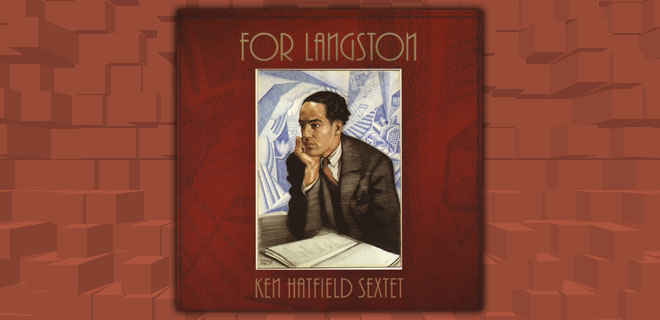
Langston Hughes is one of the great poets of the 20th century. His voice is as essential to the African American’s cry for freedom and justice as it is to the very democratic urge of all of humanity itself. It is this fact that makes him a poet for the African American as well as one for every human being.
This is because he is the author of poems of extraordinary lyric beauty quite beyond the matters of race and social justice. Indeed he comes from a long line of lyric poets including Walt Whitman and William Carlos Williams. Above all his lineage includes the great Robert Johnson, whose bottleneck Mr. Hughes’ fluid lines mimic. He also shares a lyric sense of sardonicism of Miles Davis. Indeed some of his greatest poetry—of which “Jazzonia” is only one, but a wonderful example—of the same angularity that characterized the finest compositions of Thelonious Monk. Towards the end of his life Mr. Hughes’ poems exhibited a certain sense of the reflectiveness of spirit that seemed to invoke a certain Biblical imagery, although he seemed not to be conscious of that kind of soul-searching; his poetry was, after all, almost overshadowed by his acute sense of the body politic that was at cross purposes with the politics of capitalism.
So, above all, Langston Hughes was a troubadour-poet who sang for every suffering soul in the great Human diaspora. And it is this overriding aspect of his great artistry that makes him belong to Everyman, although he is primarily a poet—without being divisive—of African America. This is exactly what is captured by Ken Hatfield in his extraordinary homage to the great poet: For Langston. This is not the first time that Mr. Hughes has appeared on a record. Caedmon released an unabridged audio-book of the poet reciting his verse and Charles Mingus made the historic record, Weary Blues (Verve, 1958) that put Mr. Hughes poems to music; and there have been other records inspired by Mr. Hughes’ poetry. But there is none like Mr. Hatfield’s monumental homage, which not only takes Mr. Hughes’ poetry across musical topography that it has never traversed before, but Mr. Hatfield also fuses the music of greater America in one of the most contemporary tributes to an artist of another generation. This is in line with the fact that Mr. Hughes is everything that he is cracked up to be and is, indeed, a poet of all of the disenfranchised of America—and of the world too.
Guitarist Ken Hatfield is a musician who has imbued the multilingual nature of American music. Like many musicians who are not African American, he is inspired by the language and literature of the blues and jazz. And like many of these musicians he is extraordinarily talented. Mr. Hatfield’s superbly cadenced music is full of the nuances of the idioms blues and jazz: their elasticity, propensity for innovation and both simple and complex melodies. To these metaphorical musical forays, Mr. Hatfield brings the effortlessness of down-home folksiness of Americana as well as all of the sophistication of classical concepts of harmonization. His guitar in fact sometimes sounds as if it were propelled by the complexity of the strings of part of a piano. On this record, polyphony meets polyrhythms. The simplicity of Langston Hughes’ poetry collides with the crying gutsiness of polyrhythmic jazz and majestic creativity in musical composition nestles cheek by jowl with the desperate everyday-ness of life as Mr. Hughes captured it and of how Mr. Hatfield also does.
The poetry of Mr. Hughes has inspired many of the charts in this astonishing song cycle. On many of the songs Mr. Hatfield has woven several poems together into a brilliant patchwork quilt that becomes a new musical soundscape for Mr. Hughes’ poetry. There is such an empathy for Mr. Hughes’ work that the music seems to belong to his poetry. This is in a very different sense to Mingus’ work that had an over-riding sense of the blues in Langston Hughes’ lyricism and idiomatic turn of phrase. Mr. Hatfield reaches further into the contemporary relevance of Mr. Hughes’ poetry, making of it an all-American song cycle. This is a first for Mr. Hughes’ work and an accomplishment for Mr. Hatfield, who has read into this poetry all of the worldliness that Langston Hughes experienced—travelling as he did to Latin America, Africa and even as far as Asia.
The musical achievement of this record also owes much to the other musicians. As a lead voice, the soprano of Hilary Gardner is one of the most important reasons for this brilliantly rendered poetry and music. The purity of her voice and the exceptional diction and expression makes her one of the finest vocalists today. She brings a sense of loftiness to the music as she does sing with all the pain and bitter-sweet joy that the interpretation of Mr. Hughes’ poetry demands. Ms. Gardner is magnificent throughout. Bassist Hans Glawischnig is another reason for the success of this record. His ingenious interpretations of this music is revealed in his masterly playing—especially in his soloing con arco as well as his playing con arco in the ensemble passages. Mr. Glawischnig’s dazzling work is showcased on “Prayer,” “Convent/Silence” and elsewhere. He captures the mighty ache that is embedded in Mr. Hughes’ poetry like someone who has known this poetry all his life. This speaks volumes for his genius and the absolute versatility of his musicianship.
Mr. Hatfield deserves special credit for the compositions, and, above all else, his exquisite arrangements. Finding Jamie Baum and her alto flute to become the harmonic voice that his guitar plays off is a master stroke. The depth of Ms. Baum’s musical gravitas adds a remarkable quality to the beauty of this recording. The percussionists—drummer Jeff Hirshfield and Steve Kroon—play beautifully throughout, adding an immense range of colours and hues to the music. This addition of shade and also texture is the reason why the essential polyrhythmic content of Mr. Hughes’ work is wonderfully adhered to.
Tracks: Overture; Dream Boogie; Not What Was; Breath Of A Rose; I Don’t Believe In Titles; Lonely Nocturne; In Time Of Silver Rain; Prayer; Silent One; Poem To A Dead Soldier; Song Of The Revolution; Convent/Silence; Jazzonia; The Bells Toll Kindly.
Personnel: Ken Hatfield: guitar; Hilary Gardner: vocals; Jamie Baum: alto flute; Hans Glawischnig: bass; Jeff Hirshfield: drums; Steve Kroon: percussion.
Ken Hatfield on the Web: www.kenhatfield.com
Label: Arthur Circle Music
Release date: February 2013 | Reviewed by: Raul da Gama


For Claudia Acuña, home has never been a fixed destination. It is something carried—in the body, in memory, in language, and in sound.
On Ave de Luz, the Chilean vocalist brings those fragments together with unusual clarity. After three decades in New York, Acuña no longer treats her roots as something to weave quietly into jazz. She places them at the center. Her striking declaration—“I’m coming in with my crown, my poncho, my everything”—captures the album’s spirit perfectly.
Raised in Concepción during Chile’s dictatorship years and later transformed by New York’s jazz scene, Acuña has spent much of her career moving between worlds. Ave de Luz feels like the moment when those worlds stop competing with one another.

A Specifically Chilean Jazz
Acuña has resisted the idea that “Latin jazz” can be reduced to a single vocabulary. Afro-Cuban and Brazilian traditions may dominate the popular understanding of the term, but Latin America contains countless rhythmic, folkloric and indigenous languages.
Her own metaphor is simple: noodles and spaghetti may look related, but they are not the same thing.
That idea shapes Ave de Luz. The album is not merely jazz with Chilean colour added to it. It is music whose identity emerges from cueca, Andean traditions, indigenous sonorities, poetry, migration and improvisation.
The trutruka, charango, zampoña, tormento and Chilean pandero become part of the album’s grammar. They interact with Manu Koch’s piano and keyboards, Carlos Henderson’s bass and Yayo Serka’s drums and percussion without sounding ornamental or exoticized.
Poetry, Memory and Resistance
“Chinga La Ka Chinga” captures one of the album’s most expansive ideas. Festive on the surface, the piece also acknowledges Afro-Chilean and northern Chilean currents, suggesting how celebration can carry history, resistance and cultural memory within its pulse.
Elsewhere, the music turns inward. “Piececitos de Niño,” inspired by Gabriela Mistral, brings poetry and childhood into the album’s emotional landscape, while “Rezo” feels almost elemental: voice, charango, atmosphere and silence shaping a meditation on nature, distance and belonging.
Acuña’s reading of Violeta Parra’s “La Jardinera” is equally significant. Its imagery of planting, tending and healing becomes an apt metaphor for tradition itself. Culture survives not by remaining untouched, but by being replanted. Acuña does precisely that.
The Wind From the South
“Viento del Sur” also carries special resonance, recalling the title of Acuña’s 2000 debut, Wind from the South. Then, the image suggested a Chilean artist arriving in the international jazz world. Here, the meaning has changed.
The south is no longer where she came from. It is something she continues to carry.
That idea finds its fullest expression in the title track. The “bird of light” becomes an image of migration without erasure—a figure moving forward while remaining connected to its place of origin. The metaphor fits Acuña herself.
Her longtime musical relationship with Koch, Henderson and Serka gives Ave de Luz much of its freedom. Years of trust let the ensemble move naturally between folk memory, jazz improvisation and contemporary textures without forcing boundaries between them.
Ave de Luz may be Claudia Acuña’s most complete artistic statement because it no longer asks her identities to compromise.
The crown is experience.
The poncho is memory.
Jazz is the road between them.
And Claudia Acuña travels that road carrying Chile fully into the light.
Album Information
- Artist: Claudia Acuña
- Album: Ave de Luz: Chilean Jazz & Soul
- Label: Delfin Records
- Release date: July 10, 2026
- Genre: Jazz / Vocal Jazz / Chilean jazz
- Format: Digital/streaming
- Final digital release: 7 tracks, approximately 36 minutes
Tracklist
- Chinga La Ka Chinga – (Claudia Acuña, Coch, Hernandez & Serka) – 4:43
- Ave de Luz– (Mario Rojas) – 5:48
- Viento del Sur– (Claudia Acuña & Jason Lindner) – 6:01
- Rezo– (Claudia Acuña) – 3:49
- Piececitos de Niño– (Based on a poem of Gabriela Mistral / Music by Claudia Acuña) – 6:10
- Un Gorro de Lana– (Víctor Acosta) – 4:18
- La Jardinera– (Violeta Parra) – 6:01
Personnel
- Claudia Acuña – vocals, percussion/claps, tormento; producer
- Manu Koch – piano and keyboards (tracks 1, 2, 3, 5)
- Carlos Henderson – bass
- Yayo Serka – drums and percussion
- Pablo Vergara – piano (tracks 6, 8)
- Andrés Pollak – piano, organ; producer (track 7) | organ (track 1)
- Pablo Zárate – accordion, Chilean pandero (track 2)
- Fredy Torralba – traditional Chilean/Andean instruments including charango, trutruka and zampoña
- Paulina García – spoken word (track 6)
- Daniel Kelley-Acuña – vocals (track 6)
Production Credits
Produced by Claudia Acuña and Andrés Pollak. Most of the sessions were recorded at East Side Sound in New York in November 2025, with “Ave de Luz” recorded at TOC Música in Santiago in October 2025 and additional recording completed at Banduria Studio in Santiago. Andrés Pollak handled engineering on the principal New York sessions; Rafael Chaparro engineered the Santiago title-track session with Javier Lizana assisting. Marc Urselli mixed and mastered the project.

With La Malinche, Eva Cortés delivers one of the most ambitious recordings of her career—a project in which history, identity, migration and music converge around one of the most contested figures in the Americas.
Malintzin, also known as Doña Marina or La Malinche, has long been portrayed through conflicting narratives: interpreter, intermediary, mother of mestizaje, victim, survivor and, in later nationalist mythology, traitor. Cortés does not try to settle that debate. Instead, she uses Malintzin as a symbol of cultural transition, displacement and survival.
That choice makes particular sense for an artist whose own life has unfolded across borders. Born in Honduras (Central America), shaped culturally in Seville (Spain) and later immersed in New York’s jazz community, Cortés has always made music from the space between traditions. On La Malinche, that in-between space becomes the heart of the album.

A Music of Crossings
The album brings together flamenco, Latin jazz, contemporary jazz and Indigenous-inspired imagery without turning the result into a forced fusion.
Rather than attempting to recreate pre-Columbian Mexican music literally, Cortés evokes Indigenous memory through percussion, communal voices, repetition and themes of ancestry, earth and maize. Flamenco enters through Spanish guitar, vocal inflection and the expressive grit associated with cante. Jazz supplies the harmonic freedom and improvisational space that allow those elements to interact.
The musicians surrounding Cortés are crucial to that balance. Pianists Pepe Rivero, Jon Cowherd and Zaccai Curtis, bassists Christian McBride, Luques Curtis and Reinier Elizarde “Negrón,” and drummers Antonio Sánchez, Adam Cruz and Georvis Pico give the album both rhythmic strength and harmonic flexibility. Roman Filiú, Paco Heredia, Marvin Sewell, Bandolero and others expand the palette further. The result is music that never feels boxed into one category.
The Voice at the Center
Cortés’ singing remains the album’s most powerful instrument. Her phrasing can be loose and conversational, then suddenly sharpen into something more urgent and flamenco-inflected. She moves between reflection, mourning, protest and defiance without sacrificing musical control.
Most importantly, she refuses to define Malintzin through betrayal. Her interpretation focuses instead on endurance and complexity.
The opening “Abuelita Malinche” immediately makes that clear. By calling her “Abuelita,” Cortés transforms Malinche from a figure of accusation into an ancestral presence. The arrangement blends Latin-jazz movement with flamenco coloration, while her wordless vocal passages move naturally between scat and cante.
“Hij@s del Maíz” extends that idea of cultural mixture. Paco Heredia’s guitar, Pepe Rivero’s piano, Antonio Sánchez’s drums and the accordion create a sound that travels across regions rather than belonging to one. Maize becomes a symbol of Indigenous continuity, while the music reflects the constantly changing character of mestizaje itself.
From History to the Present
The album becomes even more powerful when it connects the past to contemporary realities.
“Letters to Heaven” and “Remember Me” introduce themes of Indigenous loss and the disappearance of women from both historical memory and present-day communities. “Sur Global” shifts toward resistance, combining rhythmic drive with a broader reflection on colonialism, migration and inequality.
Then “Spanish Harlem” brings the journey firmly into the present. Horns, flute, tumbao and call-and-response place Cortés within New York’s Latin-jazz tradition, completing a musical path that stretches from ancestral memory to the modern city.
A Major Statement
La Malinche is more than an album built around a historical figure. It is a meditation on who controls history, who gets remembered and how identity continues to change across generations and borders.
Cortés turns her own musical hybridity into the album’s central idea. Jazz, flamenco and Latin American traditions do not simply coexist here—they help tell the story.
The result is one of her strongest and most focused recordings to date: emotionally direct, musically sophisticated and deeply rooted in the ongoing conversation between memory and transformation. La Malinche is not about recovering a pure past. It is about reclaiming the right to reinterpret it.
Album Information
- Artist: Eva Cortés
- Album: La Malinche
- Label: Truth Revolution Records / TRRcollective
- Release: June 2026
- Official press release date: June 5, 2026
- TRRcollective Bandcamp release date: June 19, 2026
- Format: CD / Digital
- Number of tracks: 11
- Total running time: 51:53
- Genre: Jazz / Latin Jazz / Flamenco / Afro-Latin
- Recorded in: Madrid, Spain, and Little Falls, New Jersey, USA
Tracklist
- Abuelita Malinche — 4:35
- A Tribo do Vento — 5:46
- Soy el Aire — 5:31
- Light and Sorrow — 3:59
- Hij@s del Maíz — 4:24
- Letters to Heaven — 5:04
- Remember Me — 3:28
- Sur Global — 5:43
- No Me Limites — 4:33
- Indians of All Tribes — 3:53
- Spanish Harlem — 4:57
Personnel
- Eva Cortés — vocals, composer, lyricist, backing vocals
- Pepe Rivero — piano, keyboards, arrangements
- Jon Cowherd — piano
- Zaccai Curtis — piano, keyboards
- Christian McBride — bass
- Luques Curtis — bass
- Reinier Elizarde “Negrón” — bass
- Paco Heredia — Spanish guitar, guitar, arrangements
- Marvin Sewell — guitar
- Roman Filiú — saxophone, flute, backing vocals
- Bobby Martínez — saxophone
- Manuel Machado — trumpet
- Antonio Serrano — harmonica
- Javier Colina — accordion
- Bandolero — percussion
- Roland Guerrero — percussion
- Antonio Sánchez — drums
- Adam Cruz — drums
- Georvis Pico — drums, vocal solo, backing vocals
Production Credits
- Produced by: Eva Cortés, Roman Filiú and Pepe Rivero
- Label: Truth Revolution Records / TRRcollective
- Session One: Camaleón Music Studio, Madrid, Spain
- Recording Engineer, Madrid: Diego Román
- Session Two: Studio Mozart, Little Falls, New Jersey, USA
- Recording Engineer, New Jersey: Kostadin Kamcev
- Mixing: David Darlington
- Mastering: David Darlington
- Mixing and Mastering Studio: Bass Hit Studios, New York, NY
- Photography: Noah Shaye

The title Abriendo Puertas—“Opening Doors”—captures the spirit of guitarist Roni Ben-Hur’s latest recording with unusual precision. Recorded in Havana with an accomplished group of Cuban musicians, the album is built not around the novelty of a visiting jazz guitarist encountering Cuban music, but around something more meaningful: musicians listening closely enough to find a common language.
Ben-Hur has spent much of his career moving naturally between musical worlds. Born in Israel to a Tunisian family and shaped professionally by New York’s jazz community, his playing draws from bebop, Brazilian music, Mediterranean traditions and Latin rhythms without sounding like a collection of influences. His years with pianist and mentor Barry Harris helped establish the melodic clarity, swing and understated sophistication that remain central to his guitar style. On Abriendo Puertas, those qualities fit remarkably well within a Cuban setting.

The key creative partner is pianist Alejandro Falcón, who contributes four of the seven compositions: the title track, “Gua’ One Blues Pal Bobby,” “Lo que es del César” and “El Teide.” Rather than treating Ben-Hur as a soloist placed in front of a Cuban rhythm section, Falcón helps create an ensemble language in which guitar and piano continuously exchange roles. Their compatibility is evident from the opening title track, where rhythmic momentum and lyrical improvisation develop patiently rather than through display.
“Gua’ One Blues Pal Bobby” pushes the conversation toward the blues while retaining a strong Cuban rhythmic identity. It is one of the album’s most spirited performances, illustrating how readily the vocabulary of jazz can coexist with the rhythmic imagination surrounding Ben-Hur in Havana. By the time the ensemble reaches “Lo que es del César” and “El Teide,” the distinction between guest and host has largely disappeared. What remains is a cohesive band responding to one another in real time.
The album’s romantic center comes through three classic Latin American songs. José Antonio Méndez’s “Mi Mejor Canción” brings the intimacy of the Cuban filin tradition into the program, while Osdalgia Lesmes appears on Isolina Carrillo’s “Dos Gardenias” and Armando Manzanero’s “Esta tarde vi llover.”
Lesmes brings warmth and emotional directness to both performances, and Ben-Hur proves once again what a sensitive accompanist he can be. His guitar surrounds the voice rather than competing with it, reflecting an approach he has developed through years of working with singers, including the late Brazilian vocalist Leny Andrade. Ben-Hur has spoken of the importance of leaving space for vocalists and allowing melody and lyric to remain at the center of an arrangement.
That same sense of space benefits the entire recording. Pedro Pablo Gutiérrez on acoustic bass, Ruy López-Nussa on drums and Octavio Rodríguez Rivera on percussion provide a foundation that is rhythmically rich without becoming overcrowded. Tenor saxophonist Emir Santa Cruz, featured on four tracks, adds another expressive voice and gives several performances a broader jazz-ensemble character.
Recorded at DBega Studios in Havana in November 2025, Abriendo Puertas is part of the Cuban Notes recording series co-produced by Ben-Hur and Dot Time Records founder Johanan “Jo” Bickhardt. Yet the album succeeds beyond the concept behind the series.
Its strength is ultimately found in the musicians themselves. Nobody appears interested in proving how effortlessly jazz and Cuban music can be combined. They simply play together until those distinctions become secondary.
For listeners who appreciate expressive jazz guitar, Cuban music and recordings where collaboration matters more than spectacle, Abriendo Puertas is easy to recommend. Warm, sophisticated and deeply conversational, it finds Roni Ben-Hur opening another musical door—and discovering an ensemble waiting on the other side.
Album Information
Artist: Roni Ben-Hur
Album: Abriendo Puertas
Label: Dot Time Records
Catalog: DT9192
Genre: Jazz / Latin Jazz
Release Date: June 26, 2026
Recorded: November 2025
Studio: DBega Studios, Havana, Cuba
Format: CD / Digital
Program: 7 tracks, approximately 49 minutes.
The project is part of Cuban Notes, co-produced by Johanan “Jo” Bickhardt and Roni Ben-Hur. It follows Alejandro Falcón’s Falcón in Blue as the second album in the series.
Tracklist
1. Abriendo Puertas – Alejandro Falcón – 8:12
2. Mi Mejor Canción – José Antonio Méndez – 6:32
3. Dos Gardenias – Isolina Carrillo – 5:23
4. Gua’ One Blues Pal Bobby – Alejandro Falcón – 9:23
5. Esta tarde vi llover – Armando Manzanero – 5:56
6. Lo que es del César – Alejandro Falcón – 6:17
7. El Teide – Alejandro Falcón – 7:49
Personnel Credits
Roni Ben-Hur — guitar
Alejandro Falcón — piano
Pedro Pablo Gutiérrez — acoustic bass
Ruy López-Nussa — drums
Octavio Rodríguez Rivera — percussion
Emir Santa Cruz — tenor saxophone, tracks 1, 4, 5 and 7
Osdalgia Lesmes — vocals, tracks 3 and 5
Production Credits
Executive Producer: Johanan “Jo” Bickhardt
Co-Producer: Roni Ben-Hur
Recorded at: DBega Studios, Havana
Recording date: November 2025
Sound Engineer: Carlos D’Bega
Label: Dot Time Records


-

 25 Most Read Posts13 years ago
Juan García-Herreros “Snow Owl” – Normas
-

 25 Most Read Posts14 years ago
Edy Martínez, the Music Architect Behind the Piano
-

 25 Most Read Posts16 years ago
Raphael Cruz Reaffirms His Commitment To Latin Jazz!
-

 25 Most Read Posts11 years ago
Rubén Blades con Roberto Delgado & Orquesta: Son de Panamá