
Concerts
Two Lessons in Ingenuity: Alfredo Rodríguez Trio & Tiempo Libre
“Rodríguez came to the world of modern music via Havana, Cuba. At that time his life, by his own…


“Rodríguez came to the world of modern music via Havana, Cuba. At that time his life, by his own admission, was all about the music of Bach, Mozart and Beethoven. Then, when he was a mere 15 years of age, an uncle gave him a copy of Keith Jarrett’s Koln Concert and the record changed his life. What imagination and what unending invention by Jarrett!”
Live Report by Raul da Gama
There must be something in and around the waters of Cuba for the generations that have drunk from these waters have and continue to produce musical artists of such astounding and unbridled genius that by their absolute numbers and in the quality of their work reasonable and elevated logic has been summarily destroyed. In recent decades this has been especially true of the pianists who have changed the course of music with the sheer magnificence of their ideas and execution. And then there is the unsurpassed technique with which they have tamed the keyboard of the piano caressing its keys; sometimes hammering it with glorious “killer tumbao” imposed upon a composition and displayed by dazzling runs and arpeggios, block chords or simply playing notes of such mystical power that listening to these feats has all but stopped the beating heart. The men of whom we speak have sometimes numbered among them geniuses such as Bebo and Chucho Valdés, Guillermo and Gonzálo Rubalcaba. Sometimes artists have arisen seemingly without precedent: Peruchín, Frank Emilio, Emiliano Salvador, Hilario Durán, Elio Villafranca, Harold López-Nussa, David Virelles and Dyramir Gonzalez to name but a few… And now there is another name to add to this seemingly never ending list: The absolutely self-effacing Alfredo Rodríguez.
Rodríguez came to the world of modern music via Havana, Cuba. There he graduated in pianoforte to the Conservatorio Amadeo Roldán, and then to the Instituto Superior de Arte. At that time his life, by his own admission, was all about the music of Bach, Mozart and Beethoven. Then, when he was a mere 15 years of age, an uncle gave him a copy of Keith Jarrett’s Koln Concert and the record changed his life. What imagination and what unending invention by Jarrett! It seemed that for Rodríguez as well, the possibilities were limitless. It was the record that also brought the young pianist to the realization that ideas did not come from music alone, “but from everything that surrounds us”. Again, in 2006 his life changed once again when he was selected to play at the Montreux Jazz Festival and invited to a soirée at the home of its Founder and Director, Claude Nobs, for the particular pleasure of Quincy Jones. The latter musician was so impressed with the ideas and ingenuity of Alfredo Rodríguez that he asked the pianist to join him in the US, where Jones became not only a mentor, but a father figure to the émigré-pianist as well. The rest is, quite literally, history for not only was Rodríguez lionized for his rare genius, but the 26-year old also quickly made a critically-acclaimed first record in the US entitled Sounds of Space (Mack Avenue, March, 2012). Today Alfredo Rodríguez is lionized wherever he goes and performs.

It is just after eight o’clock and Mervon Mehta makes a brief announcement about the third instalment of ¡Qué Rica Cuba! Series, Jazz, at the Koerner Hall of the Royal Conservatory. He reveals very little about Alfredo Rodriguez and it is just as well. Rodriguez arrives—the last of three young musicians—stage door right. He pulls off his light sweater, loosens up by joining his hands inside out and loosening his fingers. Then he rubs his palms together, blows into them and places his left hand deep into the bass clef of the keyboard. He seems to be thinking; waiting also, for a sign from Elleggua. Then he unleashes a thunderous chord and as he depresses the hard pedal to create a long sustained group of notes he rolls his left hand over itself and plays a dark and dazzling series of notes—a mini canon, from which he shoots out a quick message at bassist Ricky Rodríguez and then towards the great drummer Henry Cole, who is the first to respond with a rapid tattoo that throws the music into a dizzying roll. And after a brief response from Cole to Rodríguez’s bold entreaties, the drummer smacks his snare with a series of rim-shots, which is, in turn, a cue for the pianist to invite a growling bassist to enter the proceedings and take the song away on a stretching adventure. All the time, Rodríguez adds to the song’s grave narrative with a thunderous bass-line melody, which he expands as chapter and verse unfolds.
When Alfredo Rodríguez plays he charts a course for the melody for “Silencio,” from his first album, Sounds of Space. His roaring left hand appears to create a perimeter of sorts as his right hand traces the shape of a giant parabola. This becomes the diffused boundary within which at imaginary place of absolute peace. “Silencio” proceeds to unfold within this musical paradigm. However at its centre lies a vortex where the music churns and stirs up a storm and this accentuates the inner silence. All the while Rodríguez’s body is dancing on the piano bench. His shoulders lift and fall as he seems to create a dancing shrug. But he is not the only one who is driven to dance by the melody. He draws in his bassist and calls drummer Henry Cole to participate in that interminable dance and Cole responds with earth-shattering rim-shots and a rat-a-tat melody of his own that plays out in a circular pattern beginning on his gruff tom-toms and ending up—a few bass drum bombs and crisp smashes on his largest cymbal later—on the singing snare drum. The trio go on seemingly for hours exploring every minute measure of space, exchanging notes, making musical comments, creating whorls of music until Cole brings the song back to its original rhythmic measure and the pianist, playing a majestic figure, closes it out.
By now the trio is simmering. Rodríguez and Cole as well as Ricky Rodríguez play a teasingly familiar pattern involving piano, bass and drums: It is the first bars of “Quizás, Quizás, Quizás”. There is a velvety texture to the song and it brings to mind the delicious manner in which Nat “King” Cole enunciated the words. However, the pianist ramps up the pace of the song and delivers another Gatling gun tempo for the melody. One short verse later, the musicians are off and racing through the familiar melody, when suddenly, while Cole creates an explosive diversion, Rodríguez runs riot across the melody creating a series of lines that crisscross against each other as if they were making a cross-hatched pattern, chopping up the melody until it resembles something Thelonious Monk might play. Chords are mashed; rhythms are slanted and produce gasps from the cymbals. The song is de-constructed to such an extent that it resembles nothing that the composer Osvaldo Farrés had in mind; but has become something entirely new and of Alfredo Rodríguez’s making. The Art of De-construction continues when Rodríguez introduces that the trio will play Joseíto Fernández’s “Guantanamera”. And play they certainly do, but Rodriguez blocks the piano hammers so that when the strings are hit they sound as flat as a marimba; Cole, for his part clicks the fingers of both hands in rhythmic accompaniment occasionally knocking on the body of the snare and timpani with his knuckles. And Ricky Rodríguez plays con arco for a while before reverting to sensuous pizzicato figures. The tempo, unlike the one in which it were written is slowed down so the drama of the girl in the narrative is heightened. And then suddenly it is over, as suddenly as it started, leaving the audience gasping in wonder at the genius of the musicians who have completely re-imagined the classic while de-constructing it and re-building the song’s architecture anew. There is no time to recover from the tornado of ingenuity, for after a quick stretch part two of the lesson in ingenuity begins.

Tiempo Libre is a septet that came to Toronto via Havana, Cuba and Miami, where they are based. Theirs is an ingenuity of a different sort. Jorge Gómez, their musical director guides the septet between a vocal and instrumental group that makes music that is a magnificent collision between the baroque music of Johann Sebastian Bach. It was not a violent one, but rather one that produced a musical concussion that when the musicians recovered they realized that there is a great similarity between the contrapuntal, harmonic and motivic organisation and the adaptation of rhythms from abroad. In Bach’s case, he looked to Italy and France and with the influence with which Bach produced not only the Brandenburg Concertos, but also suites and minuets, cantatas, chorales and passions that were revered for their intellectual depth, technical command and artistic beauty. Like Bach, Tiempo Libre are able to manipulate their voices as well as the instruments that accompany them—namely the trumpet, tenor saxophone and piano –and tame these with overpowering and soaring voices—to create the soaring nature of Bach-like spirituality. Using the praise of the Orishas, which comes naturally to the Cuban Santería rituals Tiempo Libre creates a soaring musical architecture based on “guaguancó,” “son” “danzón and cha cha chá”, leaving the spiritual boleros to wrap around the styles of Bach’s sacred music.
However, by its very nature, Tiempo Libre is a free spirited group and while Afro Cuban music is driven by a complex set of rhythmic and harmonic invention just as Baroque music was, Tiempo Libre have found a way to add the Afro-Cuban content as rhythmic counterpoint to the multi counterpoint that they extract from Bach’s soaring spiritual music. As result Tiempo Libre and Bach meet somewhere in the rarefied realms where Bach’s vaunted and semi-religious music exists. Many musicians have tried to meld European counterpoint—some of them the giants of the music such as the late John Lewis and Modern Jazz Quartet. However, the scale has been expanded exponentially with the complex percussive elements provided by Afro-Cuban sound especially when trying to render Bach church music in the Afro-Cuban context—artistically—and that means calling upon the Orishas.
Here the ingenuity of Jorge Gómez’s thorough absorption of Bach’s devices and his own ability to find motivic devices that can crossover into the baroque context. The Calling of the Orishas and the ingenious use of the chékere at the hands of its most wonderful expert, Yosvany Terry this happens throughout: For instance the batá on Bach’s “Minuet in G.”
There is a superb element in this band and it is the voice of Joaquin “El Kid” Díaz. His powerful voice and daring doo when he annunciates the Afro-Cuban lyrics that describe the spiritual union with Bach are superb. Not only does he get it right as for as the proverbial collision of ideas is concerned, but he ends up edifying Bach and a glorious creator and mentor in all of their music. The presentation of the de-constructed baroque music in the form of Timba, that energetic music that brings Afro-Caribbean music to work in collusion with the baroque. And then there is the interplay of voices and instruments—all of which are played with magnificent integrity towards baroque as Afro-Caribbean music. Basses comply, horns make way for celebratory nature of the music, and at the end of the day Tiempo Libre and Alfredo Rodríguez must have done the same thing with polyphony and poly-rhythms, yet arrived at the same point via two dramatically objectives: one from a freer style and the other (Tiempo Libre), who chose to stay the course and play baroque music but innovate from within.
Thus there are two distinct styles from which ingenuity would be deduced, one full of Free and unbridled invention outside the elements of the box, meaning Alfredo Rodríguez and his trio and Tiempo Libre where change is wrought from within. Both are equally wondrous and both have succeeded in bringing the drama of two diametrically opposed and striking styles and manners of work, discipline and unbridled creativity and ingenuity that is wondrous; both are lessons in utter musical ingenuity.
Right after the concert Rubén Vázquez and his Latin Jazz Ensemble performed in the lobby, entertaining part of the audience who were still under the spell of the music on another fabulous night at Koerner Hall.
Photographs by Danilo Navas


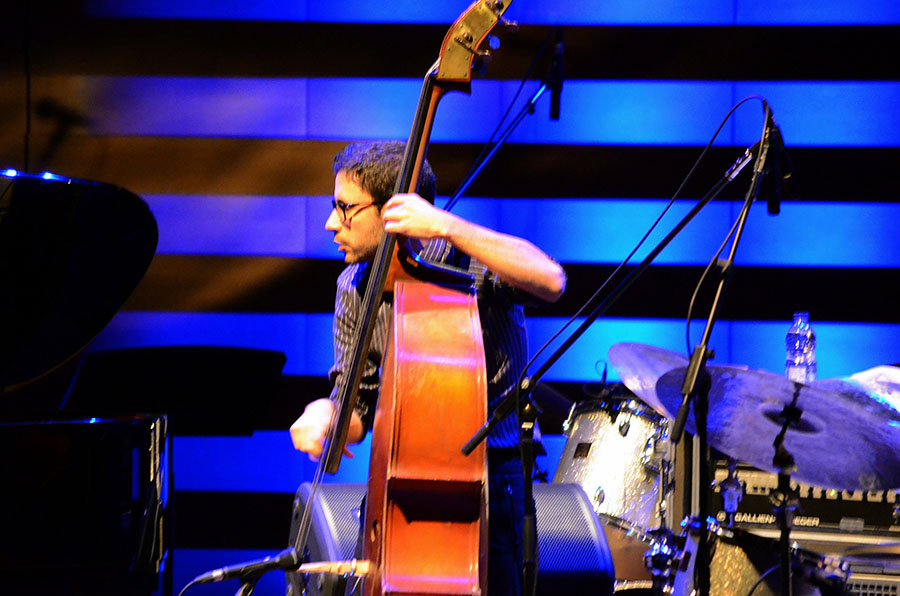
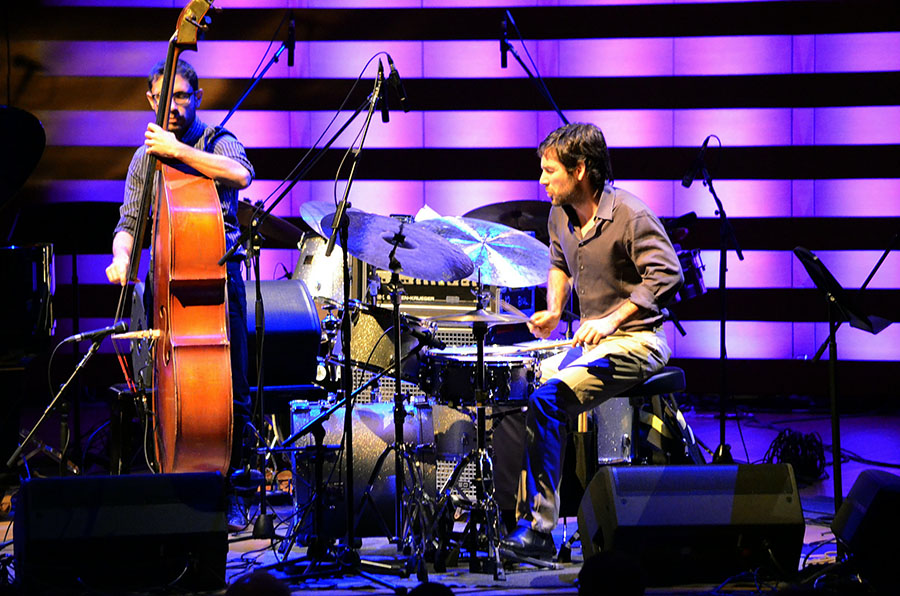


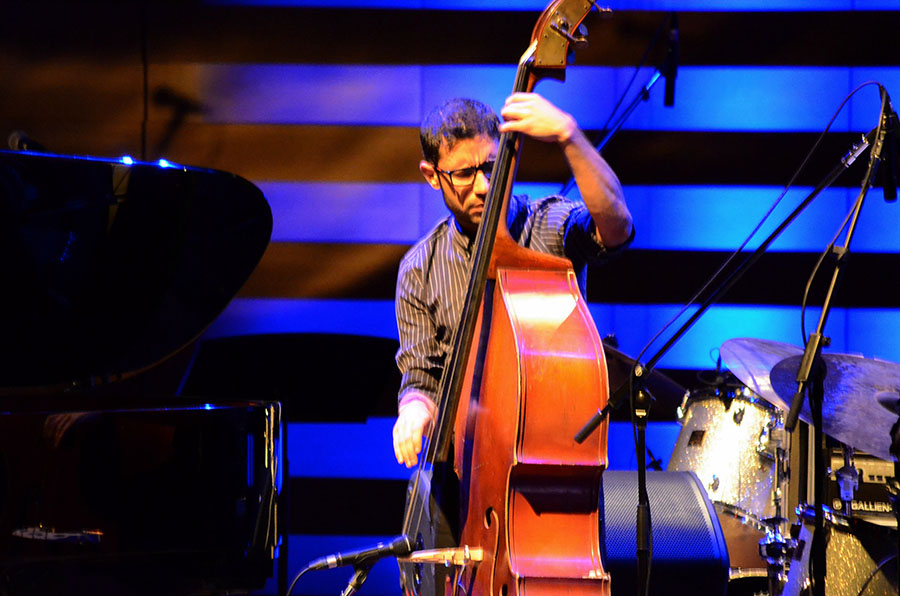


On the 22nd of May, The Sound Room on upper Broadway in Oakland, California, presented guitarist Ray Obiedo and his Latin Jazz Group. At the sold out show, Obiedo, ever the congenial host, wasted no time introducing his fine assemblage of musicians; Murray Low (piano), Jeff Cressman (trombone), Dan Feiszli (acoustic bass), Michael Spiro (percussion), Jonathan Bendich (congas) and Phil Hawkins (drums).
Ray’s composition “Criss Cross” was the opening tune, and what a blast the band had with that number. In fact, Bendich played such a swirling complex solo that his body almost left the stage. Bendich’s enthusiasm influenced the rest of the group as they all were really loose after the first tune. The next song, an Obiedo-penned number titled “True Or False”, cooked along in a 6/8 groove with Spiro on the chekere. Obiedo took a break and had Spiro give a brief lesson on one of thousands of songs found in the Afro-Cuban tradition associated with the spiritual belief system, Santería.
“Santa Lucia” was the last song in the set where Cressman and Low soloed with great feeling.

The second set opened with Milton Nascimento’s “Veracruz”, a lively samba from Brazil featuring stellar contributions from the bass and drum duo of Feiszli and Hawkins. Cressman’s muted trombone drove the groove on “Cubo Azul”, from Obiedo’s album Latin Jazz Project Vol. 1. Obiedo quite often finds room for the continuing explorations of that good old East Bay Funk. During “Cubo Azul” the band shifted gears and rode the Funk wagon aided by Spiro’s inventive timbales. To cap off the evening the classic Sonny Rollins Calypso “Saint Thomas” proved to be a perfect choice. The band tore into the tune with their collective musical prowess, not knowing that three days later Rollins would die at the age of 95. An unwittingly beautiful tribute to a jazz master.
Once again Obiedo and company lifted our spirits on that cool May night. Spiro gave the group a boost with his encyclopedic knowledge of Afro-Cuban and Brazilian rhythms, Cressman impressed on soaring trombone, Low graced the music with carefully placed notes, Bendich got quite inspired rocking back and forth to the beat, Feiszli and Hawkins maintained their patented solid underpinning, and Obiedo held the whole thing together, choosing his notes carefully and masterfully. A memorable evening of music indeed!!


On April 25, 2026, Koerner Hall became the site of something far greater than a conventional jazz performance. Presented by The Royal Conservatory of Music, the evening brought together pianist-composer Danilo Pérez, bassist John Patitucci, and drummer Brian Blade—three master improvisers whose profound musical relationship was forged during their two-decade tenure in Wayne Shorter’s legendary quartet.
The first half of the concert reaffirmed why this trio remains one of the most compelling small ensembles in contemporary jazz. The second half expanded that intimacy into something far more ambitious: the Canadian premiere of Pérez’s The Panáfrica Suite: Echoes from the Isthmus. Structured in three movements, this sweeping, large-scale work honoured Afro-Panamanian history while drawing powerful connections to the broader African diaspora across the Americas. By the evening’s end, the audience had witnessed not merely a concert but a profound artistic statement on history, resistance, survival, and cultural transformation.

From the opening notes of “Panamá Libre,” Pérez immediately established the deeply personal undercurrent running through the evening. Written during the aftermath of the United States invasion of Panamá on December 20, 1989, the composition carried both political urgency and emotional vulnerability. The composition felt especially poignant coming from an artist whose music has consistently engaged questions of identity, justice, and belonging.
The emotional heart of the trio set came with “Beloved,” dedicated to Nobel Prize-winning author Toni Morrison. Pérez delivered the piece with remarkable sensitivity, letting each note breathe and resonate with quiet emotion. The performance reflected themes often found in Morrison’s work—memory, suffering, resilience, and generational pain—while remaining deeply moving without feeling overly dramatic.

That same spirit of political engagement continued with “Alternate Realities,” dedicated to activist, scholar, and cultural icon Angela Davis. The piece felt bold and restless, with unexpected twists that created a sense of tension and unpredictability. Pérez moved between intense bursts of energy and quieter reflective moments, while John Patitucci provided powerful support with his dynamic bass playing. Brian Blade added surprising rhythmic textures that kept the performance constantly evolving, pushing Pérez toward daring and expressive improvisations.
The trio closed with Wayne Shorter’s haunting “Miyako,” and the emotional significance of that choice was impossible to ignore. Shorter’s spirit remains deeply embedded in this ensemble’s DNA. Rather than treating the composition as a nostalgic homage, Pérez, Patitucci, and Blade approached it as an evolving conversation with their late mentor—one rooted in tenderness, openness, and discovery. For longtime followers of Shorter’s quartet, this performance felt especially moving.
Patitucci and Blade remain extraordinary collaborators because they listen as deeply as they perform. Patitucci’s bass work was consistently elegant yet commanding, shifting seamlessly between melodic counterpoint and foundational groove. Blade, as always, played with remarkable sensitivity—often suggesting rhythm rather than asserting it outright. His ability to move from whisper-soft cymbal textures to thunderous eruptions remains unmatched.

After intermission, the concert transformed dramatically in scale and scope. The stage was filled with a Toronto-based big band featuring Canadian jazz icon Jane Bunnett, award-winning vocalist April May Webb, and members of the Berklee Global Jazz Institute for the Canadian premiere of Pérez’s The Panáfrica Suite: Echoes from the Isthmus, co-commissioned by the Royal Conservatory of Music.
This ambitious work explores the enduring African presence in Panamá and throughout the Americas, as well as the complex relationship between Panamá and the United States of America, centring stories that are often marginalized in official historical narratives. Pérez has described the suite as an effort to honour Afro-Panamanian heritage and celebrate “the living spirit of Africa in the Americas.” That intention resonated deeply throughout the performance.

Movement I: Afro-Panamanian Roots opened with “Bayano’s Landing,” invoking the memory of Bayano, the legendary African leader who resisted Spanish colonial forces after escaping enslavement in 16th-century Panamá. The music felt ceremonial, almost ritualistic. Dense Afro-Panamanian percussion, layered brass harmonies, and Pérez’s commanding piano work created an atmosphere of ancestral remembrance.
“Cimarrón Spirit” followed with explosive energy. Here, Pérez honoured maroon communities whose resistance shaped Afro-Panamanian identity. The arrangement surged with rhythmic complexity and dramatic ensemble interplay.

Movement II: Echoes of the Canal shifted toward the complex history of migration and labour associated with the construction of the Panamá Canal.
In “Between Two Worlds,” Pérez explored cultural hybridity through shifting rhythmic frameworks that mirrored displacement and cultural convergence. African, Caribbean, Panamanian, and jazz traditions collided and intertwined with remarkable sophistication.
“Wonder of the World” reflected both the scale of the Panamá Canal’s engineering achievement and the immense human sacrifice behind its construction. Webb delivered a stunning vocal performance here—deeply expressive, spiritually grounded, and emotionally raw.
Bunnett’s soprano saxophone work proved especially electrifying—piercing, soulful, and emotionally fearless. Her improvisation served as both narrative voice and emotional catalyst.

Movement III: Panamá brought the suite toward reflection and transcendence.
“Echoes of the Isthmus” felt almost prayerful, as though generations of ancestral voices were speaking through the music.
The closing composition, “Panamá: Land of the Butterflies,” delivered a breathtaking finale rooted in transformation and renewal. The full ensemble played with exhilarating force, building toward a triumphant ending that felt both celebratory and deeply earned.
Pérez invited the audience to sing along during the closing communal piece:
“Ola, ola, ola de la mar,
mi santa se está quemando
por falta de agua.”
Which translates as:
“Wave, wave, wave of the sea,
my saint is burning
for lack of water.”
“Ola” literally means “wave” (as in an ocean wave)
“mi santa” literally translates as “my saint,” though depending on cultural/religious context (especially Afro-Caribbean or folkloric traditions), it could carry deeper spiritual meaning.

What makes Pérez such a singular artist is his ability to merge virtuosity with vision. His compositions are never merely technical achievements—they function as vehicles for cultural preservation, political reflection, and human connection. Throughout the evening, Patitucci and Blade remained indispensable partners, while Bunnett and Webb added distinct layers of emotional and artistic depth.
At a time when conversations about migration, colonial history, race, and identity continue to shape global discourse, The Panáfrica Suite: Echoes from the Isthmus felt profoundly urgent. More importantly, it felt necessary.
At Koerner Hall, Danilo Pérez transformed history into sound—and in doing so, reminded us that jazz remains one of the most powerful vehicles for memory, truth-telling, and collective healing.


Béla Fleck, Edmar Castañeda & Antonio Sánchez: BEATrio
Something about trios demands a certain synchronicity for the format to fire as one. The players, regardless of instrumentation, must possess it — that elusive it. A simpatico where three become one, as if communication turns subliminal, each member knowing intuitively where the others are headed.
And so it was that three unlikely instruments — harp, banjo, and drums — united as one in the outstanding BEATrio.
The concert flowed from beginning to end. The trio played many songs from their self-titled 2025 album. Audience interaction was kept to a warm minimum: entering the stage to resounding applause that drew a nod and a smile from Béla Fleck, the trio took their spots and proceeded to perform with extreme dynamism, spontaneity, and that simpatico mentioned above.

After three songs — though it was hard to distinguish one from the next, the flow was so flawless — Antonio Sánchez stepped to the microphone. He made introductions and shared some engaging stories: working with Béla as a duo, and having worked with Edmar in the Paquito D’Rivera big band. The trio coming together was Béla’s idea.
Yes, it was Béla who came up with the concept. Antonio thought it was a crazy combination — but he loved it and wanted to go for it. The three gathered in the studio, had fun, made some magic, and Bela, Edmar, Antonio, Trio — BEATrio — was born.
Here they were, Antonio told us, on the second-to-last gig of their North American tour. He went on to name the songs performed: “Archipelago,” “Pellucidar,” and “Kaleidoscopes” — each one a showcase for the constant percussive energy driven by Antonio’s remarkable prowess.

Edmar Castañeda was next to take the microphone. He wanted to know how many Colombians were in the audience. A couple called out. “Two Colombians — that’s the most on the tour.” He then spoke about the next tune, born of a dark period in his life: surgery on his hand, worry about everything — but faith — and a hand now better than ever. The song: “Whispers of Resilience.”
Béla spoke last, clearly delighted with himself for writing what he called a tango — so proud, in fact, he could barely contain it. He brought it to Edmar, who declared it a cha-cha. When Antonio heard it, he said: “That’s a danzón.” And so it became “Cloak and Dagger.”
That highlight, “Cloak and Dagger” — which to my ears sounded like a samba-reggae tune — was followed by a beautiful Béla solo that conjured the sweeping romanticism of Gershwin’s “Rhapsody in Blue.”

The group closed with a piece that brought to mind dueling banjos — or rather, dueling strings — Béla coaxing the banjo through the full registers of multiple string instruments while Edmar wailed, slapped, and bent the harp into a sonic orchestral kaleidoscope.
The band received a rousing standing ovation and, in short order, returned for one final dynamic performance — the strings, dueling once again, with drumming that seemed to arrive from another world entirely.
An out-of-this-world experience: harp, banjo, and drums — who would have thought it could work?
Bravo, BEATrio!

-

 25 Most Read Posts13 years ago
Juan García-Herreros “Snow Owl” – Normas
-

 25 Most Read Posts14 years ago
Edy Martínez, the Music Architect Behind the Piano
-

 25 Most Read Posts16 years ago
Raphael Cruz Reaffirms His Commitment To Latin Jazz!
-

 25 Most Read Posts11 years ago
Rubén Blades con Roberto Delgado & Orquesta: Son de Panamá