
Concerts
Luciana Souza & Romero Lubambo in Toronto


An Affair to Remember
Concert Review: Luciana Souza & Romero Lubambo
No matter where in the world you come from or live, the seductive lure of Brasil is not only hard to resist, but of a singular nature as well. It has something to do with the food, the beaches with their attendant bodies beautiful and sensual; it is the jungles of the Amazon and the great river itself—sights and sounds so to speak, but most of all the mystique of that great country has to do with the music and musicians that it continues to beguile the world with. On April 21, 2012, two of its finest proponents were at The Toronto Center for the Arts driving an audience by turns speechless and gracefully insane.
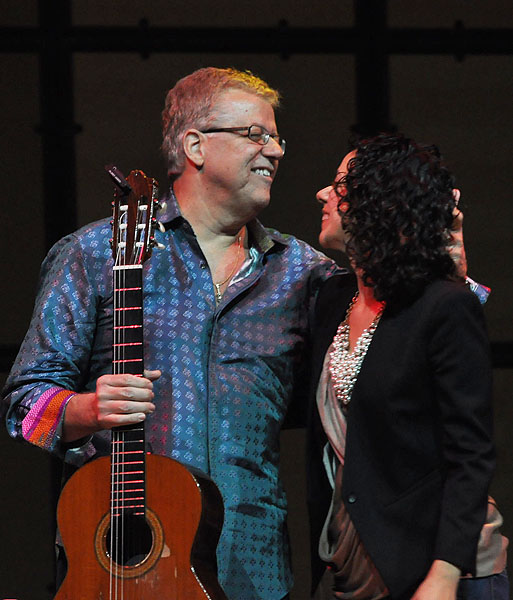
The celebrated duo of spectacular vocalist and part-time percussionist Luciana Souza and the great guitarist Romero Lubambo played non-stop for almost two hours and had the small, but knowledgeable audience spellbound. Their repertoire included classic charts from the Bossa Nova era, notably works composed by the legendary Brasileiro, Tom Jobim, a couple of choro and all of this was spiced up with a bit of Maracatú, baião, frevo and more. Souza is a vocalist with an almost three octave range and she sings with exceeding beauty. She resembles a swallow in flight, fluttering her lyrical wings as she soars upward and swoops downward. Souza also has a wonderful sense of drama and often she can bring operatic beauty to the music she delivers. There were several moments like this especially when she sang Jobim’s “Doralice” at breakneck speed and when she delivered a spectacular version of another Jobim classic, “So Danço Samba,” playing the vampish, drunken nightclub singer to the hilt. There were also a classic chart from the pen of another Brasilian legend, Toninho Horta, and a superb love song from Souza’s Pablo Neruda album and mixed in were also charts form the Great American Songbook.
Romero Lubambo comes from a long and celebrated and seemingly endless line of guitarists, who owe a debt to some of the great cavaquinho players such as Paulinho da Viola, and include great names such as Laurindo Almeida, Toninho Horta, Carlos Barbosa-Lima, Egberto Gismonti, Guinga, Marcos Tardelli, and Yamandú Costa. Lubambo showed his virtuosic side, blending the classical side with contemporary, improvisational aspects of guitar wizardry. Throughout the evening he showed why he is a first call guitarist with musicians as far removed as Yo-Yo Ma is from Claudio Roditi. More importantly, Lubambo, who has already forged a long and beautiful musical relationship with Souza, appeared to be joined at the hip with the vocalist, often seeming to anticipate where she was taking a song just as she would when he was soloing. Both Souza and Lubambo also announced that they would be releasing a third duo album on the Sunnyside Records in a little over a month and if the repertoire they played together at the concert was any indication, the record would be something to truly look forward to.
The main act of the night was preceded by the Canadian composer and pianist Amanda Tosoff and her quartet. Theirs was a short set and included material from the three albums Tosoff has released so far. The group made a last-minute change by adding Toronto celebrated bassist, Jon Maharaj, who replaced Tosoff’s regular bassist, Sean Cronin. Maharaj showed why he is so much in demand with exemplary reading of material which must have not been that familiar to him. Tosoff is a composer with a rare talent for harmonic invention. She seems to write sharply and edgily for woodwinds as well as sensitively with uncommonly beautiful viscosity for piano, she eschewed elaborate virtuoso displays during her solos, preferring brevity of harmonic statement instead. Her writing is characterized with a melodic bass line, something she probably picked up from listening carefully to the great Herbie Nichols. Saxophonist, Chris Gale was beautifully understated, especially on soprano saxophone, but his moist tone rolled exquisitely into Tosoff’s beautiful charts, “New” and “Sad Clown” from her album Wait and See. At the opposite end was drummer Morgan Childs, a wonderful percussion colorist who also provided much of the character for the quartet. The Amanda Tosoff Quartet has much to offer and her new album “Looking North” shows every indication of a deeper maturation of one of the celebrated young Canadian talents.
The Jazz Performance and Education Centre is committed to supporting the development of the next generation of jazz musicians and audience members. Through programming for students and fans of all ages, JPEC is seeking to instil a love of jazz today in those that will create and support the music tomorrow.
JPEC – www.jazzcentre.ca – is the result of collaboration between business people, musicians and arts professionals who are passionate about jazz in Toronto. Officially incorporated in 2008, the concept for the Jazz Performance and Education Centre was born in 2007 when jazz aficionados Raymond and Rochelle Koskie assembled a committee of fellow enthusiasts to address the need for a full-time jazz venue in Toronto. This first-class, multi-purpose facility will feature performances by top local, national and international jazz talent, educational programming in which fans of all ages can learn about jazz, recording facilities, a Hall of Fame and Archives which will encompass and preserve Canada’s outstanding jazz heritage and tradition. The facility will enhance Toronto’s reputation as one of the best cities in North America in which to experience live jazz.
Photo Gallery by Atael Weissman




On the 22nd of May, The Sound Room on upper Broadway in Oakland, California, presented guitarist Ray Obiedo and his Latin Jazz Group. At the sold out show, Obiedo, ever the congenial host, wasted no time introducing his fine assemblage of musicians; Murray Low (piano), Jeff Cressman (trombone), Dan Feiszli (acoustic bass), Michael Spiro (percussion), Jonathan Bendich (congas) and Phil Hawkins (drums).
Ray’s composition “Criss Cross” was the opening tune, and what a blast the band had with that number. In fact, Bendich played such a swirling complex solo that his body almost left the stage. Bendich’s enthusiasm influenced the rest of the group as they all were really loose after the first tune. The next song, an Obiedo-penned number titled “True Or False”, cooked along in a 6/8 groove with Spiro on the chekere. Obiedo took a break and had Spiro give a brief lesson on one of thousands of songs found in the Afro-Cuban tradition associated with the spiritual belief system, Santería.
“Santa Lucia” was the last song in the set where Cressman and Low soloed with great feeling.

The second set opened with Milton Nascimento’s “Veracruz”, a lively samba from Brazil featuring stellar contributions from the bass and drum duo of Feiszli and Hawkins. Cressman’s muted trombone drove the groove on “Cubo Azul”, from Obiedo’s album Latin Jazz Project Vol. 1. Obiedo quite often finds room for the continuing explorations of that good old East Bay Funk. During “Cubo Azul” the band shifted gears and rode the Funk wagon aided by Spiro’s inventive timbales. To cap off the evening the classic Sonny Rollins Calypso “Saint Thomas” proved to be a perfect choice. The band tore into the tune with their collective musical prowess, not knowing that three days later Rollins would die at the age of 95. An unwittingly beautiful tribute to a jazz master.
Once again Obiedo and company lifted our spirits on that cool May night. Spiro gave the group a boost with his encyclopedic knowledge of Afro-Cuban and Brazilian rhythms, Cressman impressed on soaring trombone, Low graced the music with carefully placed notes, Bendich got quite inspired rocking back and forth to the beat, Feiszli and Hawkins maintained their patented solid underpinning, and Obiedo held the whole thing together, choosing his notes carefully and masterfully. A memorable evening of music indeed!!


On April 25, 2026, Koerner Hall became the site of something far greater than a conventional jazz performance. Presented by The Royal Conservatory of Music, the evening brought together pianist-composer Danilo Pérez, bassist John Patitucci, and drummer Brian Blade—three master improvisers whose profound musical relationship was forged during their two-decade tenure in Wayne Shorter’s legendary quartet.
The first half of the concert reaffirmed why this trio remains one of the most compelling small ensembles in contemporary jazz. The second half expanded that intimacy into something far more ambitious: the Canadian premiere of Pérez’s The Panáfrica Suite: Echoes from the Isthmus. Structured in three movements, this sweeping, large-scale work honoured Afro-Panamanian history while drawing powerful connections to the broader African diaspora across the Americas. By the evening’s end, the audience had witnessed not merely a concert but a profound artistic statement on history, resistance, survival, and cultural transformation.

From the opening notes of “Panamá Libre,” Pérez immediately established the deeply personal undercurrent running through the evening. Written during the aftermath of the United States invasion of Panamá on December 20, 1989, the composition carried both political urgency and emotional vulnerability. The composition felt especially poignant coming from an artist whose music has consistently engaged questions of identity, justice, and belonging.
The emotional heart of the trio set came with “Beloved,” dedicated to Nobel Prize-winning author Toni Morrison. Pérez delivered the piece with remarkable sensitivity, letting each note breathe and resonate with quiet emotion. The performance reflected themes often found in Morrison’s work—memory, suffering, resilience, and generational pain—while remaining deeply moving without feeling overly dramatic.

That same spirit of political engagement continued with “Alternate Realities,” dedicated to activist, scholar, and cultural icon Angela Davis. The piece felt bold and restless, with unexpected twists that created a sense of tension and unpredictability. Pérez moved between intense bursts of energy and quieter reflective moments, while John Patitucci provided powerful support with his dynamic bass playing. Brian Blade added surprising rhythmic textures that kept the performance constantly evolving, pushing Pérez toward daring and expressive improvisations.
The trio closed with Wayne Shorter’s haunting “Miyako,” and the emotional significance of that choice was impossible to ignore. Shorter’s spirit remains deeply embedded in this ensemble’s DNA. Rather than treating the composition as a nostalgic homage, Pérez, Patitucci, and Blade approached it as an evolving conversation with their late mentor—one rooted in tenderness, openness, and discovery. For longtime followers of Shorter’s quartet, this performance felt especially moving.
Patitucci and Blade remain extraordinary collaborators because they listen as deeply as they perform. Patitucci’s bass work was consistently elegant yet commanding, shifting seamlessly between melodic counterpoint and foundational groove. Blade, as always, played with remarkable sensitivity—often suggesting rhythm rather than asserting it outright. His ability to move from whisper-soft cymbal textures to thunderous eruptions remains unmatched.

After intermission, the concert transformed dramatically in scale and scope. The stage was filled with a Toronto-based big band featuring Canadian jazz icon Jane Bunnett, award-winning vocalist April May Webb, and members of the Berklee Global Jazz Institute for the Canadian premiere of Pérez’s The Panáfrica Suite: Echoes from the Isthmus, co-commissioned by the Royal Conservatory of Music.
This ambitious work explores the enduring African presence in Panamá and throughout the Americas, as well as the complex relationship between Panamá and the United States of America, centring stories that are often marginalized in official historical narratives. Pérez has described the suite as an effort to honour Afro-Panamanian heritage and celebrate “the living spirit of Africa in the Americas.” That intention resonated deeply throughout the performance.

Movement I: Afro-Panamanian Roots opened with “Bayano’s Landing,” invoking the memory of Bayano, the legendary African leader who resisted Spanish colonial forces after escaping enslavement in 16th-century Panamá. The music felt ceremonial, almost ritualistic. Dense Afro-Panamanian percussion, layered brass harmonies, and Pérez’s commanding piano work created an atmosphere of ancestral remembrance.
“Cimarrón Spirit” followed with explosive energy. Here, Pérez honoured maroon communities whose resistance shaped Afro-Panamanian identity. The arrangement surged with rhythmic complexity and dramatic ensemble interplay.

Movement II: Echoes of the Canal shifted toward the complex history of migration and labour associated with the construction of the Panamá Canal.
In “Between Two Worlds,” Pérez explored cultural hybridity through shifting rhythmic frameworks that mirrored displacement and cultural convergence. African, Caribbean, Panamanian, and jazz traditions collided and intertwined with remarkable sophistication.
“Wonder of the World” reflected both the scale of the Panamá Canal’s engineering achievement and the immense human sacrifice behind its construction. Webb delivered a stunning vocal performance here—deeply expressive, spiritually grounded, and emotionally raw.
Bunnett’s soprano saxophone work proved especially electrifying—piercing, soulful, and emotionally fearless. Her improvisation served as both narrative voice and emotional catalyst.

Movement III: Panamá brought the suite toward reflection and transcendence.
“Echoes of the Isthmus” felt almost prayerful, as though generations of ancestral voices were speaking through the music.
The closing composition, “Panamá: Land of the Butterflies,” delivered a breathtaking finale rooted in transformation and renewal. The full ensemble played with exhilarating force, building toward a triumphant ending that felt both celebratory and deeply earned.
Pérez invited the audience to sing along during the closing communal piece:
“Ola, ola, ola de la mar,
mi santa se está quemando
por falta de agua.”
Which translates as:
“Wave, wave, wave of the sea,
my saint is burning
for lack of water.”
“Ola” literally means “wave” (as in an ocean wave)
“mi santa” literally translates as “my saint,” though depending on cultural/religious context (especially Afro-Caribbean or folkloric traditions), it could carry deeper spiritual meaning.

What makes Pérez such a singular artist is his ability to merge virtuosity with vision. His compositions are never merely technical achievements—they function as vehicles for cultural preservation, political reflection, and human connection. Throughout the evening, Patitucci and Blade remained indispensable partners, while Bunnett and Webb added distinct layers of emotional and artistic depth.
At a time when conversations about migration, colonial history, race, and identity continue to shape global discourse, The Panáfrica Suite: Echoes from the Isthmus felt profoundly urgent. More importantly, it felt necessary.
At Koerner Hall, Danilo Pérez transformed history into sound—and in doing so, reminded us that jazz remains one of the most powerful vehicles for memory, truth-telling, and collective healing.


Béla Fleck, Edmar Castañeda & Antonio Sánchez: BEATrio
Something about trios demands a certain synchronicity for the format to fire as one. The players, regardless of instrumentation, must possess it — that elusive it. A simpatico where three become one, as if communication turns subliminal, each member knowing intuitively where the others are headed.
And so it was that three unlikely instruments — harp, banjo, and drums — united as one in the outstanding BEATrio.
The concert flowed from beginning to end. The trio played many songs from their self-titled 2025 album. Audience interaction was kept to a warm minimum: entering the stage to resounding applause that drew a nod and a smile from Béla Fleck, the trio took their spots and proceeded to perform with extreme dynamism, spontaneity, and that simpatico mentioned above.

After three songs — though it was hard to distinguish one from the next, the flow was so flawless — Antonio Sánchez stepped to the microphone. He made introductions and shared some engaging stories: working with Béla as a duo, and having worked with Edmar in the Paquito D’Rivera big band. The trio coming together was Béla’s idea.
Yes, it was Béla who came up with the concept. Antonio thought it was a crazy combination — but he loved it and wanted to go for it. The three gathered in the studio, had fun, made some magic, and Bela, Edmar, Antonio, Trio — BEATrio — was born.
Here they were, Antonio told us, on the second-to-last gig of their North American tour. He went on to name the songs performed: “Archipelago,” “Pellucidar,” and “Kaleidoscopes” — each one a showcase for the constant percussive energy driven by Antonio’s remarkable prowess.

Edmar Castañeda was next to take the microphone. He wanted to know how many Colombians were in the audience. A couple called out. “Two Colombians — that’s the most on the tour.” He then spoke about the next tune, born of a dark period in his life: surgery on his hand, worry about everything — but faith — and a hand now better than ever. The song: “Whispers of Resilience.”
Béla spoke last, clearly delighted with himself for writing what he called a tango — so proud, in fact, he could barely contain it. He brought it to Edmar, who declared it a cha-cha. When Antonio heard it, he said: “That’s a danzón.” And so it became “Cloak and Dagger.”
That highlight, “Cloak and Dagger” — which to my ears sounded like a samba-reggae tune — was followed by a beautiful Béla solo that conjured the sweeping romanticism of Gershwin’s “Rhapsody in Blue.”

The group closed with a piece that brought to mind dueling banjos — or rather, dueling strings — Béla coaxing the banjo through the full registers of multiple string instruments while Edmar wailed, slapped, and bent the harp into a sonic orchestral kaleidoscope.
The band received a rousing standing ovation and, in short order, returned for one final dynamic performance — the strings, dueling once again, with drumming that seemed to arrive from another world entirely.
An out-of-this-world experience: harp, banjo, and drums — who would have thought it could work?
Bravo, BEATrio!


-

 25 Most Read Posts13 years ago
Juan García-Herreros “Snow Owl” – Normas
-

 25 Most Read Posts14 years ago
Edy Martínez, the Music Architect Behind the Piano
-

 25 Most Read Posts16 years ago
Raphael Cruz Reaffirms His Commitment To Latin Jazz!
-

 25 Most Read Posts11 years ago
Rubén Blades con Roberto Delgado & Orquesta: Son de Panamá