
Featured
Luis Damian Güell: The Man Behind The Sound
Luis Damian Güell was born on September 28th, 1953 in the provincial city of Cienfuegos, in Cuba, where he attended the Marist Primary School between 1958 and 1960. The Marist Brothers are a Catholic religious order of brothers and affiliated lay people. The order was founded in France, at La Valla-en-Gier near Lyon in 1817 by Saint Marcellin Champagnat, a young French priest of the Society of Mary (Marist Fathers) […]


Feature written by: Chico Alvarez Peraza
Luis Damian Güell was born on September 28th, 1953 in the provincial city of Cienfuegos, in Cuba, where he attended the Marist Primary School between 1958 and 1960. The Marist Brothers are a Catholic religious order of brothers and affiliated lay people. The order was founded in France, at La Valla-en-Gier near Lyon in 1817 by Saint Marcellin Champagnat, a young French priest of the Society of Mary (Marist Fathers).
After leaving Cuba with his family, young Luis continued his studies at the Marist Primary School in Madrid, Castile, Spain between 1965 and 1968. Eventually his family settled in Hudson County, in northern New Jersey, where he attended Memorial High school in the town of West New York from 1968 to 1972. He was a mere stone’s throw away from the capital of the music business, New York, and his eye was on the apple.
Recently, Luis brought me up to date on his formative years in the recording industry.
"After graduating high school, I enrolled in the Manhattan School of Music in nearby New York City, where I studied composition, electronic music and recording arts and science with the renowned Fred Plaut, then Senior Engineer for the Masterworks Dept. at The Columbia Records 30th Street Studio in New York. This was the same studio where seminal figures such as Bob Dylan, Johnny Cash, Billie Holiday, Tony Bennett, Miles Davis, Mongo Santamaría, Muhammad Ali, and Charles Mingus had recorded their best work".
For anyone who is not familiar with the analog recording industry in its heyday, the 30th Street Studio was located at 207 East 30th Street, between 2nd and 3rd Avenues in Manhattan. It was originally an Armenian Greek Orthodox church. Abandoned after the war, the church was transformed in 1949 into one of the world’s greatest recording studios, where some of the most dynamic and enduring music was created. Bob Dylan’s "Highway 61 Revisited"; Leonard Bernstein’s "West Side Story,"; Miles Davis’s "Kind Of Blue" and Glenn Gould’s interpretations of Bach’s "Goldberg Variations," were all recorded there.
Under Plaut’s supervision, Luis Güell interned as his assistant at the 30th Street Studio from 1972 to 1974. The studio provided a distinctive ambience, featuring a kaleidoscope of sublime sonic qualities unparalleled in the recording industry. Young Luis soon found himself in the company of masters. His first session as an intern was with Leonard Bernstein playing the piano and conducting the Columbia Symphony Orchestra. It turns out that the aforementioned recording was the classic Gershwin tune "Rhapsody in Blue". Luis was only 19 years old at the time.
He fondly recalls: "I nearly died when I had to ask Bernstein to please play the piano so I could mic it. At that time 30th Street Studios only recorded classical and jazz with some Broadway shows cast albums sprinkled in between. I do not remember any pop, folk or country being recorded there, those sessions were usually recorded at the 52nd Street Studios. Needless to say, I was in heaven".
From ‘74 to ’77 Luis worked closely with C/O Banner Talent in New York, serving as liaison to Latin American booking agencies and clients, creating both musical and vocal arrangements, supervising road and sound crews, and serving as bassist and musical director for the touring group which backed The Shangri-Las (Leader Of The Pack, Walking in The Sand, Give Him A Great Big Kiss, etc.).
In March of 1978 he designed and became the co-owner of A Step Above Studios, which was located at 281 5th Avenue in Manhattan. He worked there until ’85 as studio manager, engineer and producer, supervising staff, handling bookings, promotion, production and recording of music and commercial spots (jingles) for radio and television. He served as the account executive for all the Spanish and French speaking Latin American and European clients.
"It was a time of great creativity and fusion for the Afro-Cuban sound. As I remember it, that’s when I recorded Orlando ‘Puntilla’ Rios’ album ‘From La Habana to New York’, as well as an unreleased album titled ‘Cuban Commandos’ that featured among others, Puntilla, Olufemí, and the newly arrived Paquito D’Rivera. Many disco era and very early rap projects were recorded there as well. But as fate would have it, I felt the need to move on, so in early 1985 I began an association with Sight & Sound Management Ltd., located at 156 W. 57th Street. They later moved to 200 5th Avenue. It was run by Bob Schwaid, who managed such artists as Miriam Makeba, Van Morrison (he produced ‘Astral Weeks’ for him), Al Green, Evelyn ‘Champane’ King, the SOS Band and many others. Bob would later become a partner and president at World Beat Records. He died in 2002 and is greatly missed by all of us who worked with him. My association with Bob really opened me up to new ideas, as well as giving me a unique insight into the business side of the recording industry."
For the next two years Luis labored arduously at Sight & Sound as staff producer and personal manager for various artists in music, television and cinema. By 1986 he had already produced Mick Wilson for RCA Records (London) and several singles for Man Eating Plants. During this period he continued to work with Latin American and European clients as well, freelancing from ’72 to ’86 as a bassist, mostly in Manhattan, with the Dan Early Trio, John Adamo, and groups such as Turn Down Broadway, Adobo and Palma.
In 1987 he joined the staff at Ultrasonic Recording in West New York, New Jersey as chief engineer and studio manager. "The Penthouse", as it was known, soon became the recording mecca for many recording artists from the Hudson County area. Luis would stay there until 1996, doing music and sound recording, basic maintenance and trouble shooting of equipment, while also supervising staff and freelance engineers. While at Ultrasonic, he received both Gold and Platinum Record awards from WEA Caribe for his engineering work on the Frankie Negrón debut CD “Con Amor Se Gana”. He worked out of this studio for a good part of the decade.
By 1992 Luis was supervising all areas of production and engineering of “The Meme Solís Show" for NPR’s Radio Martí, preparing material for broadcast into Cuba. He then opened up his own studio, Digital Boulevard Audio in West New York, New Jersey, where he took on the task of handling all phases of production, from recording to manufacturing, including: liner notes, artwork, graphics, printing, coordinating promotion, advertising and distribution departments for World Beat Records, a Jazz and World Music record company that unfortunately went out of business in 2001.
He remembers it as a time of growth: "Digital Boulevard Audio was actually created in ’92 as an editing and mastering facility for Ultrasonic . At that time it was located at "The Harbor Towers", also on Boulevard East before moving to its current location in Fairview, N.J. in ’99. We started producing Meme’s show in the early 90’s at The Penthouse and then moved it to Digital Boulevard’s studio after Ultrasonic closed. The industry was growing and changing, and I was growing and changing right along with it. And there certainly was a lot of teamwork involved back then. I was part of the team that designed and built Ultrasonic’s Penthouse Studio and I’m really proud of that".
Luis Güell’s devotion to his craft and to Digital Boulevard has given him the opportunity to work with many formidable artists, such as Carlos Santana, Rashied Ali, Claudio Roditi, Sonny Fortune, Jocelyn, Juan Angel Gonzalez, Sergio Brandau, José Luis Quintana "Changüito", David Oquendo, Carlos Enríquez, Ogduardo "Roman" Díaz, Pedrito Martínez, Ivan Bodley, Genya Ravan, Sergio George, Papo Luca, Farnkie Negrón and Pedro Capó.
Some of his big-time clients have been Sony-BMG and Arista Records, as well as many other well known labels. Looking at his most recent work, it pleases me to say that he has been recognized for the following: The 3rd Latin Grammy Awards – Nominated Work “Best Traditional Tropical Album” for the Nelson Gonzalez release “Pa’ los Treseros” (recorded and mixed); the 4th Latin Grammy Awards – Nominated Work “Best Folk Album” for “Raíces Habaneras” self titled (recorded, mixed and mastered); the 47th Grammy Awards – Winner of “Best Latin Jazz Album” for “Bebop Timba” by Raphael Cruz (produced, recorded, mixed and mastered); the 52nd Grammy Awards – Nomination “Best Latin Jazz Album” for “Things I Wanted To Do” by Chembo Corniel (mastered).
Currently he is putting the finishing touches on an album for noted Cuban songwriter Cheín Garcia, who in the past has written music for Enrique Iglesias, Carlos Santana, Lara Fabian and Frankie Ruiz. There is also a live album for Puerto Rican pop singer Brendaly that is nearing completion. Both Chein’s and Brendaly’s Albums are due to be released shortly.
Luis’ expertise includes the art of mastering, which is what he is best noted for these days.
Basically, mastering is the shaping, sculpting, equalizing, compressing and fine tuning of sound through both analog and digital audio processing. In Luis’ capable hands each individual track in a production is given depth, punch, clarity and volume. It is more than just a science, it involves a certain craft, and of course a keen ear for the music. Most technicians involved in audio engineering and mastering are musicians, or at least musically inclined. It is an art that is widely misunderstood and sometimes even mistaken for mixing. It’s the last step which comes just before the manufacturing of a recording. It’s a crucial step for many. For Luis, it’s the pièce de résistance. He is currently mastering "Casino Rueda" for latin singer Luisito Rosario, as well as Willy Torres’ NYC Salsa Project. It is the second album that he has mastered for this upcoming artist.
Recently, I asked Luis Güell if there were any other new and interesting projects in the works.
"I’m currently working on editing, mixing and mastering of a formidable live concert by ‘Grupo Folklorico y Experimental de Nueva York’. It was produced by René López, who was also responsible for the quintessential groundbreaking New York Afro-Latino folkloric project, known by the same name, back in the early seventies. The music for this new version will be part of the soundtrack for an upcoming documentary. Also, I have recently recorded ‘Don Pancho Terry’ for Chembo Corniel’s next album. As far as Digital Boulevard is concerned, we have just concluded major acoustic and equipment upgrades this past April, including Lipinski L707 monitors and a Rupert Neve designed ‘Masterpiece Analog Mastering Unit’ with ‘Lavry’ converters. I’m really excited about this, as I now have at my disposal the type of state of the art technology that is needed in order to continue helping out independent artists like Raphael Cruz, Miguel García and Ochún and David Oquendo".
With all these achievements under his belt, we at Latinjazznet.com would like to wish Mr. Luis Damian Güell the best of luck in all of his future endeavors and we sincerely hope that you, our readers, have enjoyed our reportage on "the man behind the sound".


MLO and the Living Heart of New York Mambo.
The title carries the confidence of musicians who have already made their case on countless bandstands. With No Hay Que Hablar — ‘Nuff Said! (which translates as There’s No Need To Talk — ‘Nuff Said!), the Mambo Legends Orchestra brings decades of experience into a programme that connects mambo, salsa, bolero, and jazz through the expressive possibilities of the Latin big band. Its strongest argument lies in the relationship between generations: musicians who worked beside the architects of this music join distinguished guests and younger collaborators to sustain a demanding, deeply communal art.
Released on October 2, 2026, through Truth Revolution Recording Collective, the eleven-track album places familiar repertoire alongside original compositions. Vocal storytelling and instrumental improvisation share the foreground, reflecting a tradition whose sophistication remains inseparable from its invitation to dance.

New York, the Palladium, and a Musical Inheritance
New York is essential to understanding the orchestra’s significance. Cuban musical traditions encountered the city’s jazz orchestras, Puerto Rican communities, and culture of musical exchange, generating new approaches to rhythm, arranging, and improvisation. The Palladium Ballroom became a celebrated meeting place, associated with Machito, Tito Puente, and Tito Rodríguez—the Big Three.
The dance floor mattered as much as the bandstand. Arrangers sustained movement while introducing harmonic colour, ensemble drama, and opportunities for invention. Dancers responded, participating in an exchange that helped shape Latin jazz and New York Latin dance music.
The Mambo Legends’ founding leaders—musical director and timbalero José Madera, saxophonist and flutist Mitch Frohman, and the late bongosero John “Dandy” Rodríguez—spent substantial portions of their careers with Tito Puente. Their experience reaches beyond the written score: supporting a singer’s phrasing, building momentum through percussion, and weaving solos into the orchestra’s conversation.
José Madera and the Art of the Orchestra
Madera connects historical experience with contemporary orchestral thinking. His father, José “Pin” Madera, was a founding member and early arranger of Machito’s orchestra. The younger Madera spent thirty-one years with Puente, including fifteen as musical director, developing his craft through family inheritance and sustained professional collaboration.
His arrangements bring coherence to a programme filled with distinctive personalities. Accommodating celebrated singers and soloists while preserving the ensemble’s character requires both imagination and discipline. Opportunities distributed across reeds, brass, piano, and percussion reinforce the collective nature of the project.
Bassist Gerardo “Jerry” Madera, conguero George Delgado, and pianist Zaccai Curtis help support that vision. Their roles underline how closely the rhythmic foundation, arranged passages, vocal exchanges, and improvised statements depend on one another.

Guests Who Extend the Conversation
“Sabroso Guaguancó” pairs Eddie Palmieri’s piano with José Alberto “El Canario,” connecting two formidable personalities within New York’s Afro-Caribbean musical world. Their participation makes the opening selection a compelling introduction to the album’s community of artists.
Gilberto Santa Rosa appears on “La Rumbantela,” featuring trumpeter Pete Nater, and “Camagüey (Piñeiro Tenía Razón),” featuring Richard Viruet. These pairings create opportunities for dialogue between vocal expression and instrumental commentary, illustrating the continuity between big-band arranging and the craft of the salsa sonero.
Tony Vega takes the spotlight on “Que Me Digan Feo,” while Tito Nieves joins “Empego Naroco,” featuring Rodríguez on bongos. Rodríguez’s recorded presence carries particular resonance, preserving the contribution of a musician who connected successive generations of New York Latin music.
The orchestra’s own singers remain central. Frankie Vázquez, Cita Rodríguez, Marco Bermúdez, and Jorge Maldonado provide its vocal foundation. Vázquez leads several tracks, keeping the ensemble’s familiar vocal character at the heart of the recording.
Gershwin, Cha-Cha-Chá, and a Father’s Dedication
“I’ve Got a Crush on You” is among the programme’s most revealing choices. Madera recasts the Gershwin standard as a mambo, with Vázquez singing and John Walsh and Doug Beavers featured on trumpet and trombone. The concept reflects New York’s long history of musical exchange, demonstrating how rhythm and orchestration can open familiar repertoire to fresh interpretation.
“Preludio en Ritmo” brings Frohman’s flute together with Bermúdez’s voice in a cha-cha setting, broadening the programme’s palette through a different balance of instrumental colour and melodic expression.
A more intimate perspective emerges in “De Papi Con Amor (From Daddy With Love).” Frohman composed this bolero for his daughter. Danny Rivera supplies the vocals, Frohman is featured on tenor saxophone, and the late Ray Santos contributed the arrangement. A father’s affection gives the album’s theme of inheritance a personal dimension.
Such tenderness belongs naturally within the orchestra’s expressive range. Alongside the excitement of mambo, the programme makes space for family, reflection, and the emotional intimacy of song.
The Ensemble Takes the Spotlight
“El Trabajador” features Vázquez with trombonist Jimmy Bosch and trumpeter Viruet. “Abaniquito” brings together Vázquez, alto saxophonist Bobby Porcelli, Nater, and Madera on timbales. Both selections highlight the individual contributions that give a collective sound its personality.
Madera’s original composition and arrangement “The MLO Swing” closes the album with an instrumental showcase for Walsh, trombonist Tokunori Kajiwara, Porcelli, and Curtis. Ending with new music affirms the orchestra’s continuing creativity and its contribution to the tradition these musicians have carried forward.
That commitment extends to educational work and the documentary Mambo Legends: The Music Never Ends. Performance and teaching allow the ensemble’s accumulated knowledge to reach new audiences and musicians, making cultural preservation an active, shared responsibility.
With its blend of Afro-Cuban rhythms, jazz orchestration, and distinguished musical voices, No Hay Que Hablar — ‘Nuff Said! is a compelling choice for Latin music and jazz enthusiasts alike. The Mambo Legends Orchestra draws on decades of collaboration to carry New York’s rich musical heritage forward with conviction and imagination. Explore the individual contributions, appreciate the ensemble’s shared artistry, and discover how much this enduring tradition still has to offer.
Album Information
- Artist: The Mambo Legends Orchestra
- Album: No Hay Que Hablar — ‘Nuff Said!
- Label: Truth Revolution Recording Collective
- Release date: October 2, 2026
- Formats: CD and digital download
- Tracks: 11
- Running time: Approximately 66 minutes
- Musical styles: Mambo, salsa, Afro-Cuban big band, Latin jazz, cha-cha-chá, bolero
- Listen or purchase: Official Bandcamp release
Complete Tracklist
- Sabroso Guaguancó — 7:13
Featuring Eddie Palmieri, piano; José Alberto “El Canario,” vocals. - I’ve Got a Crush on You — 7:25
Featuring John Walsh, trumpet; Doug Beavers, trombone; Frankie Vázquez, vocals. - La Rumbantela — 5:50
Featuring Pete Nater, trumpet; Gilberto Santa Rosa, vocals. - Preludio en Ritmo — 7:40
Featuring Mitch Frohman, flute; Marco Bermúdez, vocals. - Que Me Digan Feo — 5:09
Featuring Tony Vega, vocals. - Empego Naroco — 6:13
Featuring John “Dandy” Rodríguez, bongos; Tito Nieves, vocals. - De Papi Con Amor (From Daddy With Love) — 3:56
Featuring Mitch Frohman, tenor saxophone; Danny Rivera, vocals. - Camagüey (Piñeiro Tenía Razón) — 5:38
Featuring Richard Viruet, trumpet; Gilberto Santa Rosa, vocals. - El Trabajador — 6:26
Featuring Jimmy Bosch, trombone; Richard Viruet, trumpet; Frankie Vázquez, vocals. - Abaniquito — 5:56
Featuring Bobby Porcelli, alto saxophone; Pete Nater, trumpet; José Madera, timbales; Frankie Vázquez, vocals. - The MLO Swing — 5:00
Instrumental featuring John Walsh, trumpet; Tokunori Kajiwara, trombone; Bobby Porcelli, alto saxophone; Zaccai Curtis, piano.
Personnel Credits
Expanded personnel listing
Leadership
- José Madera — musical director, timbales, arrangements and orchestration
- Mitch Frohman — co-leader, tenor saxophone, flute
- John “Dandy” Rodríguez — co-leader, bongos, cowbell, güiro
Saxophones and flute
- Bobby Porcelli — alto saxophone
- Vito Chiavuzzo — alto saxophone
- Mitch Frohman — tenor saxophone, flute
- Peter Brainin — tenor saxophone
- Jorge Castro — tenor saxophone (track 6)
- Pedro Miranda — baritone saxophone
Trumpets
- Kevin Bryan
- John Walsh
- Richard Viruet
- Pete Nater
Trombones
- Sam Burtis
- Doug Beavers
- Tokunori Kajiwara
- Jimmy Bosch
Piano, bass, and percussion
- Zaccai Curtis — piano
- Yeissonn Villamar — piano (tracks 4, 5, 6)
- Gerardo “Jerry” Madera — bass
- Luques Curtis — bass (track 1)
- José Madera — timbales
- George Delgado — congas
- Richie Bastar — congas (tracks 5, 6)
- John “Dandy” Rodríguez — bongos, cowbell, güiro
Vocals and coros
- Frankie Vázquez
- Cita Rodríguez
- Marco Bermúdez
- Jorge Maldonado
Special guests
- Eddie Palmieri — piano
- José Alberto “El Canario” — vocals
- Gilberto Santa Rosa — vocals
- Danny Rivera — vocals
- Tony Vega — vocals
- Tito Nieves — vocals
Production and Technical Credits
- Musical direction: José Madera
- Principal arrangements and orchestration: José Madera
- Additional arrangers: Ray Santos and Gonzalo Fernández
- Re-orchestration: Richard Viruet
- “De Papi Con Amor (From Daddy With Love)”: composed by Mitch Frohman; arranged by Ray Santos
- “The MLO Swing”: composed and arranged by José Madera
- “I’ve Got a Crush on You”: arranged by José Madera
References
- Mambo Legends Orchestra — “About Us.”
- Mambo Legends Orchestra — “Meet the MLO Musicians.”
- TRRcollective. No Hay Que Hablar — Nuff Said! — Official album listing.
- Mambo Legends Orchestra. No Hay Que Hablar — ‘Nuff Said! — Press release — Lydia Liebman Promotions.
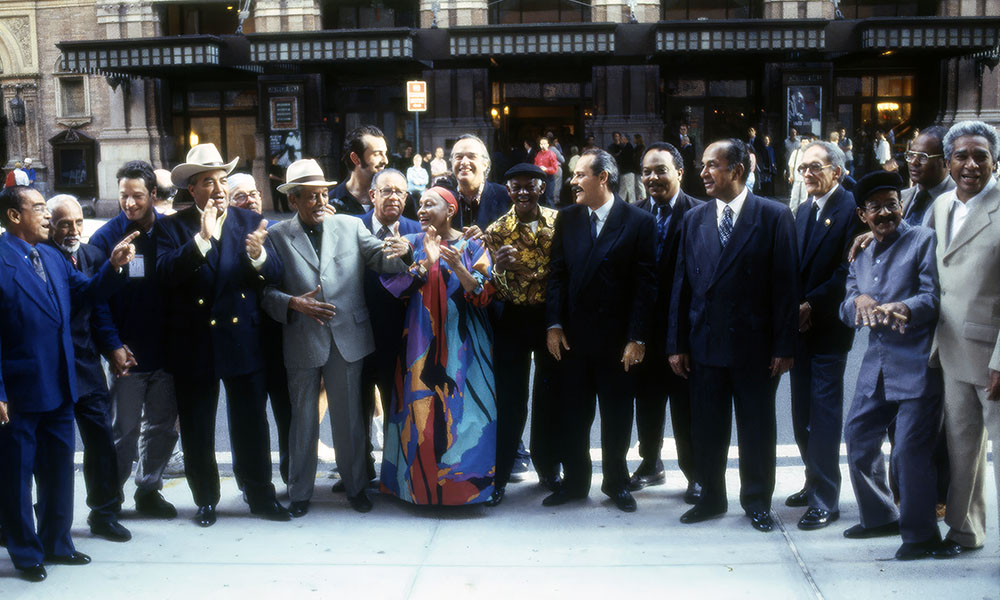
On March 26, 1996, inside the wood-panelled EGREM/Areito studios in Centro Habana, a group of musicians gathered without knowing they were about to make one of the most consequential recordings in modern Cuban music. The repertoire reached deep into son, bolero, danzón and canción, and behind every note stood decades of experience.
Cuban bandleader Juan de Marcos González, American guitarist and producer Ry Cooder, and British producer and World Circuit co-founder Nick Gold brought together veterans including Ibrahim Ferrer, Eliades Ochoa, Compay Segundo, Rubén González and Omara Portuondo. Over seven extraordinary days, they recorded Buena Vista Social Club, an album whose intimacy would eventually travel around the world.
Thirty years later, the record has sold more than eight million copies, inspired Wim Wenders’ Oscar-nominated documentary, returned Cuban masters to international prominence and found new life on Broadway. Now World Circuit Records marks the anniversary with a “Pearl Sunrise” double-LP edition that brings the story back to where it began: musicians sharing a room.

The Magic of EGREM Studios and the Havana Sessions
The Buena Vista story has always carried the aura of chance. Gold’s original Havana project envisioned a collaboration between Cuban and West African musicians. When the African participants were unable to make the journey, attention shifted toward the extraordinary musicians already available in Cuba.
What followed was not so much the “discovery” of unknown artists as the international reintroduction of musicians with deep histories of their own. Compay Segundo had spent decades within the son tradition. Rubén González was one of Cuba’s most distinctive pianists. Omara Portuondo was already a major singer. Eliades Ochoa brought the rural pulse of eastern Cuba, while Ibrahim Ferrer emerged as one of the project’s defining voices.
The EGREM room became part of the album’s character. Large, resonant and wood-panelled, it allowed the ensemble to record largely as a live unit, preserving the responsive quality of musicians hearing one another and shaping the performance collectively. World Circuit credits that environment with playing a major role in the final recordings’ singular sound.
That atmosphere is audible throughout. González’s piano converses with singers and rhythm section; Orlando “Cachaíto” López gives the music its supple bass foundation; Compay Segundo carries both pulse and memory; Ferrer turns a lyric into intimate speech. Cooder’s role was most effective when unobtrusive, helping create conditions in which the musicians’ individual personalities remained central.
The result was neither glossy modernization nor museum reconstruction. It sounded alive because it was allowed to breathe.
From Local Treasure to Global Phenomenon
When Buena Vista Social Club appeared internationally in 1997, few could have predicted the scale of its reception. The album moved far beyond specialist audiences and became a gateway into Cuban music for listeners around the world.
“Chan Chan,” written by Compay Segundo, became its defining invitation. Built on a circular guitar figure and an unhurried groove, the song became both the album’s opening statement and its unofficial anthem—an instantly recognizable portal into the sound of Buena Vista.
The record went on to sell more than eight million copies. At the 40th Annual GRAMMY Awards in 1998, Buena Vista Social Club won Best Tropical Latin Album, confirming that the project had crossed cultural and commercial boundaries without surrendering its identity.
Wim Wenders’ 1999 documentary expanded that impact. By following the musicians in Havana and on international stages, the film gave audiences a visual and human dimension to voices they had come to love. It earned an Academy Award nomination for Best Documentary Feature and helped transform Ferrer, Segundo, González, Portuondo and their colleagues into international cultural figures.
The album also opened the way for a broader World Circuit catalogue of Cuban projects, including major recordings by Ferrer, Portuondo, González and Guajiro Mirabal. Buena Vista became not an endpoint, but a doorway.

From Havana to Broadway
Perhaps the clearest proof of the album’s longevity is its remarkable 21st-century theatrical life.
Buena Vista Social Club opened at Broadway’s Gerald Schoenfeld Theatre on March 19, 2025, reshaping the album’s cultural memory into a dramatic work inspired by the musicians and the history surrounding their music. Its song score is sung entirely in Spanish, while the dramatic scenes are performed in English—a format World Circuit describes as a Broadway first.
At the 2025 Tony Awards, the production earned four competitive wins: Natalie Venetia Belcon for Featured Actress in a Musical, Jonathan Deans for Sound Design, Patricia Delgado and Justin Peck for Choreography, and Marco Paguia for Orchestrations. The musicians in the show’s band also received a Special Tony Award, giving the production five Tony honours in total.
In February 2026, the Original Broadway Cast Recording won the GRAMMY Award for Best Musical Theatre Album. Music first captured in Havana three decades earlier had not merely survived; it had found a new dramatic language and another award-winning recorded life.
That momentum continues with the 2026–27 U.S. national tour, which began in Buffalo on September 12, 2026, before moving through cities across the United States. The Buena Vista story has become a living cultural work, continually rediscovered by new audiences.
The 30th Anniversary “Pearl Sunrise” Edition
World Circuit’s Buena Vista Social Club: 30th Anniversary Edition, released September 4, 2026, turns attention back to the original record.
Pressed on “Pearl Sunrise” colored double vinyl, the set uses the 2021 remaster and arrives in a gatefold sleeve with a 20-page collectible booklet. It is the third title in World Circuit Records’ 40th Anniversary reissue series.
The edition wisely avoids trying to reinvent the album. The 2021 remaster preserves the qualities that have always defined Buena Vista Social Club: natural room ambience, detailed acoustic instruments, warm voices and the uncanny sensation that the listener is sitting near the ensemble rather than hearing music assembled behind studio glass.
For collectors, the most significant addition is Side D, which gathers five rare bonus recordings:
- “Vicenta”
- “La Pluma”
- “A Tus Pies”
- “La Cleptómana”
- “Orgullecida (Alternate Trio Take)”
These tracks deepen the historical experience of the sessions rather than distracting from it. They offer further glimpses of repertoire and chemistry, suggesting just how much musical possibility surrounded those seven days at EGREM.
The pearl-colored vinyl gives the edition a commemorative identity, while the gatefold presentation and booklet transform it into both an archival object and a listening experience. For listeners who already own the album, the attraction is not simply another pressing, but a physical edition designed to mark the distance the music has travelled.

World Circuit at 40
The reissue also arrives during World Circuit Records’ 40th anniversary, placing Buena Vista Social Club within a broader story of cultural exchange.
Under Nick Gold’s direction, the label has spent four decades connecting international audiences with music from Cuba, West Africa and beyond. Its catalogue includes landmark work by Ali Farka Touré, Oumou Sangaré, Toumani Diabaté, Orchestra Baobab and Fatoumata Diawara, as well as recordings involving Tony Allen, Hugh Masekela and numerous Cuban artists.
World Circuit’s strongest releases have always trusted specificity: distinctive artists, careful production and the belief that audiences will respond to music on its own terms.
Buena Vista Social Club remains the clearest example of that philosophy.
Thirty Years Later
Thirty years can turn almost any landmark album into a monument. Buena Vista Social Club has resisted that fate because it still feels less like history than presence.
“Chan Chan,” “Dos Gardenias,” “El Cuarto de Tula,” “Candela” and the title track retain the warmth, humour, longing and spontaneity that allowed them to travel so widely. The musicians never sound as though they are performing their own legend. They sound like people making music together.
That may be the album’s deepest achievement. It restored global attention to remarkable Cuban artists, but it did so through performances that never required historical explanation to communicate.
The Broadway production has carried those songs to another generation. The national tour is extending their reach again. And the “Pearl Sunrise” 30th Anniversary Edition now offers listeners another reason to return to the source.
For longtime admirers, it is a beautifully presented way to revisit an essential recording. For collectors, the bonus material and expanded package make it a meaningful edition. For new listeners, it is an invitation to enter the same room that opened in Havana in March 1996.
Drop the needle on “Chan Chan,” and thirty years disappear.
References
World Circuit Records. “Buena Vista Social Club 30th Anniversary Vinyl Edition.” Official press release, 2026. Source for the anniversary edition, original Havana sessions, sales history, musicians, Broadway resurgence, World Circuit history and bonus material.
The Recording Academy. “40th Annual GRAMMY Awards.” GRAMMY.com. Official record of Buena Vista Social Club winning Best Tropical Latin Album at the 1998 GRAMMY Awards. (Grammy)
The Recording Academy. “Best Musical Theater Album — 68th Annual GRAMMY Awards.” GRAMMY.com, 2026. Official record of the Buena Vista Social Club Original Broadway Cast Recording’s GRAMMY win. (Grammy)
Academy of Motion Picture Arts and Sciences. “The 72nd Academy Awards — 2000.” Official record of Wim Wenders and Ulrich Felsberg’s Buena Vista Social Club nomination for Documentary Feature. (Oscars)
The American Theatre Wing / The Broadway League. “Buena Vista Social Club.” TonyAwards.com. Official production, nomination and award record for the 2025 Broadway musical. (Tony Awards)
Buena Vista Social Club — The Musical. Official U.S. National Tour schedule, 2026–27. (Buena Vista Musical)


For three days in August, downtown San José, California, was the epicenter of some great music in the SF Bay Area. We heard bands that put a contemporary spin on music of the last century, from the Latin soul sounds of Joe Bataan to the sophisticated singing of René Marie, and a particular highlight for me was the performance by the one and only Patti LaBelle. This year marked forty years that the Festival has been in existence, and I hope it goes on for at least forty more years. With new director Christian Vela doing an outstanding job of booking, the future of the Festival looks bright.
Friday Night: Soul, Zydeco, and Latin Rhythms
MC for the Main Stage was Greg Bridges, a mainstay in Bay Area radio for many years, currently at KCSM 91.1 on the FM dial. It is always reassuring to hear his voice at the Festival, as I know some enjoyable music will follow. Sure enough, Adi Oasis came out that Friday night and gave a good opening performance. Handling the vocals and the electric bass playing, she impressed the crowd with her musicianship. Oasis brought us back to 1998 with her version of Lauren Hill’s “Doo Wop (That Thing)” mixed in with some slow jams and her own material. Oasis’ music was a nice way to ease into the Festival atmosphere.
On the Blues/BigEasy Stage, local group Zydeco Flames held forth with their southern Louisiana sound. They took some familiar New Orleans favorites like Fats Domino’s “Hello Josephine” and “Iko Iko,” added some washboard and accordion and turned them into Zydeco tunes. One of the most notable songs was an original waltz called “Never Alone.” Then the dancers came out in full force when they broke into Hank Williams’ “Jambalaya.” Rock guitar wafted through B.B. King’s “The Thrill is Gone” and The Staple Singers’ “I’ll Take You There.” Zydeco Flames proved that any tune can be turned into a Zydeco song.
Moving on to the Latin Tropical Stage, 83-year-old Joe Bataan and his band revived the Latin-soul sounds that he pioneered in the ’60s. There were echoes of Doo Wop and classic ’50s R&B along with the conga drum to give the music a Latin twist. Bataan was in good spirits, starting off singing “The Lord’s Prayer” with his wife and then getting into some serious boogaloo. He dedicated one song to the Philipinos and another to the Puerto Ricans, even plunging into some of what could be called “Oldies But Goodies.” The horn players, C.P. Salas (tenor saxophone) and Tony Hernández (trumpet), kept the old-school vibe going. Guitarist Adrian Carmine took a solo turn singing that old chestnut “Daddy’s Home,” and Bataan showed he could croon with the best of them on “I Wish You Love.” The packed crowd reveled in the nostalgia-laden music, proving that Joe Bataan is back!
My friend Jonathan told me about Thee Sinseers several weeks before I caught them at the Festival, and if it is ’60s Rhythm & Blues with a Mexican flair, there is no better band. Led by the vocals of Joey Quiñones, Thee Sinseers lay down a heart-on-your-sleeve, slow jam sound that never lets up. Teasing the audience with the horn riff from Tower of Power’s “You’re Still A Young Man,” they took us back to a time when cars were big, and everyone went to the soda fountain to put quarters in the jukebox. Proud of their East Los Angeles heritage, the group plays a kind of updated version of LA bands from the ’60s like Thee Midnighters. “Little” Willie Garcia, lead vocalist of Thee Midnighters, must be very happy to hear this music seeing a resurgence in popularity.
Saturday: New Voices and Veteran Masters
On to Saturday, where the Monterey Jazz Vocal Ensemble sang with great harmony in the San José Art Museum. Comprised of high school students and recent high school graduates, the Ensemble performed a variety of tunes from all over the map. With 12 singers (7 women and 5 men), they poured out a strong, tight-knit sound. Backed by a quartet of high school-age musicians, the Ensemble sang Chick Corea’s “You’re Everything” and a bossa nova-tinged “Angel Eyes.” It was a most enjoyable way to start the second day of the Festival.
Drummer Mike Clark’s Post Boptet band took the early afternoon slot at the Montgomery Theater, going through an exciting hour of contemporary music. The Post Boptet boasts a superb lineup: Eddie Henderson (trumpet), Craig Handy (tenor saxophone), Essiet Okon Essiet (acoustic bass) and David Kikoski (piano). They began with a very appropriate tune, “East Broadway Rundown” by the recently departed Sonny Rollins. After a wonderful ballad featuring Henderson, they played a jazz/funk hybrid called “Loft Funk,” where Clark got to display his formidable chops on drums. Then in a kind of tribute to Herbie Hancock, the band dug into his composition “Toys.” Three of the members of the band were employed by Hancock at various points in his career: Henderson during the Mwandishi period, Clark during the Head Hunters time and Handy on the road with Herbie. All three musicians have ties to the SF Bay Area: Henderson played music and practiced psychiatry in the Bay for many years, Handy is the son of John Handy, born in Oakland, and Clark was born in Sacramento. New York-based pianist Kikoski has played with a wide range of jazz musicians, so it was a treat to finally see him live. With his white hair flying in all directions, Kikoski was in constant motion, swaying to the music, seemingly possessed. Clark’s new album, Kuan Ganjo (Time Without Beginning), has the same cast minus Kikoski and adds Patrice Rushen. It is definitely worth a listen or two or three.
Back at the Main Stage, Parlor Greens were into their set, a groove-oriented Hammond B3, electric guitar and drum sound harkening back to the ’50s and ’60s soul/jazz records. The guitarist Jimmy James laid down tantalizing chords and single-line notes while Tim Carman supplied the heavy backbeat. The organist was a fill-in for Adam Scone and did a very nice job during their set. An interesting thing happened during Parlor Greens’ set: James said they were going to play a Dolly Parton song and the audience had to guess which one. Well, this is a hip crowd, and they came up with “Jolene” right away. Again, it was reassuring to find out that the organ trio concept is still alive and being taken a step forward with Parlor Greens.
One of the great things about the Festival is finding new acts that are surprisingly good. Such was the case with the Nicole Zuraitis Quartet, an original singer/pianist/songwriter, whose self-deprecating manner and voice charmed the crowd. Starting with her own compositions, Zuraitis sang and played piano with wondrous dexterity. The band, husband Dan Pugach (drums), Sam Weber (acoustic bass) and Idan Morin (electric guitar), supported Zuraitis with steady assurance. After singing her own tunes, Zuraitis then broke into a series of covers: “Jolene” (hearing it a second time in the space of an hour), “The Nearness of You,” “Wichita Lineman” and “I Get Along Without You Very Well,” all done with taste and feeling.
Roger Glenn, preeminent musician extraordinaire, plays 18 different instruments and presented his group that Saturday afternoon to a very enthusiastic audience at the Signia Regent Stage. Taking most of the material from his 2025 album My Latin Heart (produced by special guest Ray Obiedo), the group navigated seven tunes, enjoying every moment. Switching between vibes, flute, alto saxophone and percussion, Glenn made the most of his countless abilities. Obiedo contributed his composition “Child’s Dance” and his inimitable stinging electric guitar. Glenn noted early on that he and Obiedo have been playing music together for 55 years, quite a long and fruitful association. Longtime band members, Marcos Silva on electric piano, Robb Fisher on acoustic bass, Michelle Gerlitz on congas and percussion and newcomer Kelly Fasman on drums played with supreme cohesion. Late in the set, Gerlitz and Glenn picked up chekeres and held the audience spellbound for a while. Glenn and company left a prodigious amount of excellent music in our ears that afternoon.

Saturday Evening: Afro-Cuban Fire and Patti LaBelle
The Main Stage hosted the always enjoyable Afro-Cuban All Stars led by Juan De Marcos González. The talent level in Cuba is so deep that I didn’t recognize any of the current band members. It might be that the original group had some of the older established artists, and many have passed away or are unable to travel. Be that as it may, the All Stars were in fine form that evening, showcasing a singer with a declarative style. As De Marcos González stayed in the background playing the güiro, the band executed intricately arranged passages. Horns and percussion were tightly knit together in a delicate balance.
A short walk to the Latin Tropical stage where Orquesta Akokán began their re-creation of classic Cuban music from the ’40s and ’50s. Focusing on the Mambo, Orquesta Akokán brought back that familiar sound from the past. Pianist and arranger Michael Eckroth dove deep into the genre, respecting the past and adding his own ideas to create a modern take. The music was enhanced by the vocals of Kiko Ruiz, who handled the crowd, exuding natural charisma. The electric tres guitar combined with the soaring horns made the set quite enjoyable. Akokán means from the heart in Yoruba, and the group proved that they had plenty of it on that sultry night in San José.
Wedged in between Orquesta Akokán and headliner Patti LaBelle, Jubu Smith soulfully sang and played guitar. Born and raised in Oakland, California, Jubu borrows liberally from gospel, soul, blues and funk to display his singular electric guitar playing. Last year he was seen at the Summer Festival backing up Lilah Hathaway; this year headlining the Blues/Big Easy Stage. Hammond B3 organ (Mike Halberg), electric bass, and drums backed Jubu’s compelling vocals and superior guitar work. B.B. King’s immortal “The Thrill Is Gone” was a perfect vehicle for Jubu’s mastery. Nodding our heads, the crowd acknowledged Tony! Toni! Toné!’s song “Anniversary,” which the normally reserved Jubu said he helped the group record. After a long time spent backing other artists, Jubu finally struts his stuff and leads his own group.
The ageless Patti LaBelle sang her way into our hearts with fire and consummate expertise. At 82 years young, LaBelle showed absolutely no signs of slowing down. All the high and low notes were there; a stellar performer, having the time of her life. Her longtime pianist/musical director, Sam Lewis, made all the musical transitions smooth and seamless. One of her backup singers took center stage for the Staple Singers’ “I’ll Take You There” while LaBelle was busy changing her wig and clothing. LaBelle returned to the stage and continued to entrance all the folks, from the front of the stage to those seated in the back in their lawn chairs.
Sunday: Ska, Miles Davis, and René Marie
The first act on Sunday, hitting the Main Stage at precisely 1 p.m., the Western Standard Ska Orchestra took us back to Jamaica in the ’50s, when Ska music was at its peak. Trumpeter Eitan Avineri directed the band, some twenty instruments including a full horn section; trumpets and saxophones filled the stage along with guitar, acoustic bass and drums. Invoking the sounds of yesteryear and using the template of the Skatalites (The group who invented ska), the Orchestra blasted out a huge, powerful sound. Using Lee Morgan’s “The Sidewinder,” the Orchestra left no doubt that Ska and Jazz could co-exist in the same song. I found myself bopping up and down to the highly percussive ska rhythm, another unexpected musical treat.
Educator and bassist Marcus Shelby led a nonet which faithfully revisited the Miles Davis session Birth Of The Cool. Highly appropriate choice of material, as this year many artists are celebrating Miles’ centenary. Each selection introduced by Shelby received an informative description, noting the composer and the principal soloist. The nonet, composed of all Bay Area musicians, featured Heidi Tretheren (horn), Remee Ashley (trombone), Mike Olmos (trumpet), Tony Pebbles (alto saxophone), Melecio Magdaluyo (baritone saxophone), Jonathan Seiberlich (tuba), Greg Jacobs (piano), Jamal Ramírez (drums) and Marcus Shelby (acoustic bass). Especially notable contributions came from Olmos, Pebbles and Magdaluyo as they filled the shoes of Miles Davis, Lee Konitz and Gerry Mulligan. The music still sounded quite fresh, even though the record was made almost 80 years ago. “Boplicity,” “Jeru” and “Budo” came to precise and vivid life under Sheiby’s direction. Birth of the Cool was not treated as some museum piece by this group—to be dusted off and only played on special occasions—instead as a vital part of American music history.
I was really looking forward to hearing Lakecia Benjamin, having experienced her wonderful alto saxophone playing. To my surprise, she could not make the gig; instead, the replacement was the marvelous vocalist René Marie. Backed by an exceptional trio—Xavier Davis on piano, Elias Baily on acoustic bass and Quentin E. Baxter on drums—Marie sang a medley of tunes around the theme of imagination; the Temptations’ “Just My Imagination” was the core, with a deviation into John Lennon’s “Imagine.” Marie told a great story associated with her original tune, “Colorado River Song.” Her trip down the river with a man resulted in a wonderful thing: marriage. There was a call-and-response scat singing with the audience, where Marie showed off her considerable scat singing abilities. Marie captivated the crowd with her warm and inviting songs, a pleasant surprise for everyone.
The Women Who Lit Up the Festival
Sure, there were some cool moments in the Festival: Joe Bataan crooning, Afro-Cuban All Stars dealing, Jubu Smith playing guitar, even the Western Standard Time Ska Orchestra skanking, but the soul of the summer Jazz Fest belonged to the women, who played and sang their hearts out.
The Festival this year was worth attending due in no small part to the powerful women who graced all of the stages. From Adi Oasis to Nicole Zuraitis, on to Patti LaBelle and ending with the incomparable René Marie, women and their considerable gifts made the Festival exceedingly bright.
Artists Performing at the San José Summer Jazz Fest 2026
Photo Gallery by Brooks Geiken (click to enlarge)


-

 25 Most Read Posts13 years ago
Juan García-Herreros “Snow Owl” – Normas
-

 25 Most Read Posts14 years ago
Edy Martínez, the Music Architect Behind the Piano
-

 25 Most Read Posts16 years ago
Raphael Cruz Reaffirms His Commitment To Latin Jazz!
-

 25 Most Read Posts11 years ago
Rubén Blades con Roberto Delgado & Orquesta: Son de Panamá