
News
Celebration for Celia Cruz: “Celia y Willie” Vinyl Reissue


Los Angeles (April 9, 2025)—Craft Latino continues the year-long centennial celebration of Celia Cruz with a reissue for Celia y Willie, her timeless collaboration with legendary bandleader Willie Colón. Featuring such favorites as “Dos jueyes,” “Latinos en Estados Unidos,” and “Cucurucucú paloma,” the 1981 release marked the second of three albums from the superstar pair. Arriving on June 6th, and available for pre-order today, Celia y Willie has been remastered from its original master tapes by Clint Holley and Dave Polster at Well Made Music and pressed on 180-gram vinyl. A limited-edition “Oro Suave” (soft gold) color vinyl variant (limited to 300 copies), with an exclusive bundle option that includes a collectible Vaya Records logo T-shirt, is available at Fania.com.
Throughout 2025, Craft Latino is honoring Celia Cruz and her incredible contributions to the musical landscape with a series of vinyl and digital reissues, playlists, video content, and more. Visit the Celia Cruz Centennial page for more details about the celebration. As one of the most influential Latin artists of all time, Cruz was an internationally beloved star who sold over 10 million records during her five-decade-long career. A ten-time GRAMMY® nominee, Cruz was honored throughout her life and beyond with numerous awards, exhibits, commemorative stamps, samples by major artists, and tributes, including a National Medal of the Arts, a Smithsonian Lifetime Achievement Award, a star on the Hollywood Walk of Fame, and a posthumous GRAMMY® Lifetime Achievement Award. Cruz was also inducted into the Billboard Latin Music Hall of Fame and the International Latin Music Hall of Fame, among others, while in 2024, she became the first Afro-Latina to appear on U.S. currency through the American Women’s Quarter Program.

Known around the world as “The Queen of Salsa,” legendary Cuban singer Celia Cruz (1925 – 2003) rose to fame in the early ’50s as a member of the celebrated vocal group, La Sonora Matancera. After a decade of hit records, film roles, and international tours, however, the singer was forced to flee her country, following the Cuban Revolution. Settling in New York City, Cruz launched a solo career, collaborating with the era’s biggest Latin stars—most famously Tito Puente—before signing to Fania Records imprint, Vaya Records, in the mid-’70s. There, Cruz embarked on her most successful era yet, beginning with the bestselling 1974 salsa classic, Celia & Johnny (with Fania co-founder Johnny Pacheco). Over the next few years, her star continued to rise, as she joined the legendary supergroup Fania All Stars and released a string of acclaimed albums, including the GRAMMY-nominated Eternos (with Pacheco) in 1978. This era also found Cruz branching out to collaborate with other Fania stars, including Pete Rodriguez (for 1980’s Celia, Johnny and Pete) and legendary bandleader, composer, and producer, Willie Colón.
A multiple GRAMMY and Latin GRAMMY nominee, Willie Colón (b. 1950) shaped the sound of salsa through his prolific work on and off the stage. A native of The Bronx, Colón launched his storied career at just 15 years-old when he signed to Fania Records. Partnering with another rising star, singer Héctor “El Cantante” Lavoe, Colón became a sensation in the Latin music scene—thanks in large part to the duo’s 11 genre-defining albums, including 1967’s El malo, 1970’s Cosa nuestra, and the 1971 Christmas classic, Asalto Navideño.
By the mid-’70s, however, Colón had shifted his focus to projects behind the scenes as a composer, producer, arranger, and musical director. This era also found him exploring a variety of solo projects and broadening his network of collaborators, working with the likes of Rubén Blades and Celia Cruz. The latter partnership—between the “Queen of Salsa” and “El Malo del Bronx”—began with 1977’s Only They Could Have Made This Album. The dynamic pairing, which featured Cruz on vocals and Colón as producer and bass trumpeter, would prove to be highly successful.
Among the highlights are the electric hit “Dos jueyes,” the vivacious “Kirimbambara,” and “Mi caso,” an empowering tune that declares multiple reasons why a woman would not want to get married. Other standout tracks include the socially conscious “Latinos en Estados Unidos” and a salsa-fied cover of the iconic Mexican song “Cucurucucú paloma,” as well as the irresistible “Come Down to Miami.” Despite the English title, the latter tune is primarily in Spanish and encourages New York-based Latinos to escape the cold and relocate to sunny Miami.
Celia y Willie proved the pair’s magic, once again, while the album’s popularity found Cruz and Colón reuniting one more time for 1987’s Winners. Today, more than four decades after its release, the 1981 LP remains a salsa classic. AllMusic writes that a Cruz/Colón collaboration “is to salseros what a Marvin Gaye/Tammi Terrell duet is to soul lovers or an Ella Fitzgerald/Louis Armstrong project is to jazz enthusiasts; in other words, you’re bringing together two of the best artists that the genre has to offer. When Cruz and Colon get together, the sparks usually fly—and Celia y Willie is no exception.”
Click here to pre-order Celia y Willie.
Click here to find the exclusive bundle including the “Oro Suave” color vinyl with a collectible Vaya Records T-shirt.
Vinyl Tracklist*
Side A: 1. Mi caso; 2. Cucurucucú paloma; 3. Ya lo puedes decir; 4. Latinos en Estados Unidos; 5. Berimbau.
Side B: 1. Dos jueyes; 2. Kirimbambara; 3. Come Down to Miami; 4. Apaga la luz; 5. Hay que recordar.
*Digital tracklist mirrors Vinyl
About Fania
Highly influential, both musically and culturally, Fania Records spread the sound of salsa music from the clubs of New York City to the rest of the world and became a revered global brand in the process. Fania’s master recording catalog is the definitive home for genres such as Latin big band, Afro-Cuban jazz, boogaloo, salsa and Latin R&B and includes artistic giants such as Celia Cruz, Willie Colón, Héctor Lavoe and Rubén Blades. With the creation of the international supergroup known as the Fania All-Stars, the label’s signature musical style became known as the “Fania Sound.” Fania’s rich master catalog also includes the Pete Rodriguez’s boogaloo classic “I Like It Like That”? which was sampled by Cardi B in her #1 hit “I Like It.” Additionally, three Fania Recordings, Celia & Johnny by Celia Cruz and Johnny Pacheco, Azúcar Pa’ Ti by Eddie Palmieri and Live at Yankee Stadium by the Fania All-Stars, appear in the National Recording Registry, a list of sound recordings that “are culturally, historically or aesthetically important, and/or inform or reflect life in the United States.” For more info, visit Fania.com.
About Craft Latino
Craft Latino is home to one of the largest and most prestigious collections of Latin music master recordings and compositions in the world. Its rich and storied repertoire includes legendary artists such as Antonio Aguilar, Joan Sebastian, Pepe Aguilar, Celia Cruz, Héctor Lavoe, Willie Colón, Ray Barretto, La Lupe, Ruben Blades and the Fania All Stars, to name just a few. Renowned imprints with catalogs issued under the Craft banner include Musart, Fania, TH, Panart, West Side Latino and Kubaney, among many others. Craft creates thoughtfully curated packages, with a meticulous devotion to quality and a commitment to preservation, ensuring that these recordings endure for new generations to discover.
Craft Latino is the Latin repertoire arm of Craft Recordings. The catalog label team for Concord. For more info, visit CraftRecordings.com.



The Vince Guaraldi Trio’s A Charlie Brown Christmas has been certified six times platinum by the Recording Industry Association of America, representing six million album sales and streaming equivalents in the United States. According to Craft Recordings, that distinction makes the 1965 soundtrack the best-selling jazz album of all time. The news follows two anniversaries celebrated in 2025, when Charles M. Schulz’s Peanuts comic strip turned 75 and the animated Christmas special marked 60 years since its television debut.
Craft celebrated the milestone with a series of 2026 vinyl reissues, from an all-analogue pressing cut from the original master tapes to a limited-edition LP with snowflakes floating inside. At the heart of each edition is a piano trio recording that introduced generations of television viewers to jazz, often before they knew what to call the music they were hearing.

How Vince Guaraldi gave Peanuts its sound
Guaraldi’s association with Charlie Brown began in 1964, when producer Lee Mendelson was filming A Boy Named Charlie Brown, a documentary about Schulz and his comic strip. To write the score, Mendelson turned to Guaraldi, a Bay Area pianist whose composition “Cast Your Fate to the Wind” had earned him a Grammy. The documentary never aired, but Mendelson remembered the score. When he began work on A Charlie Brown Christmas the following year, he called Guaraldi back.
The half-hour special premiered on December 9, 1965, drawing nearly half of the American television audience that evening. It went on to win Emmy and Peabody awards and became an annual holiday tradition. Guaraldi continued composing for Peanuts specials until his death in 1976.
With bassist Fred Marshall and drummer Jerry Granelli among the musicians who took part in the sessions, Guaraldi found a distinct rhythm for each scene. The insistent left-hand piano figure of “Linus and Lucy” set the children dancing at their Christmas pageant rehearsal. On “Skating,” descending piano phrases suggested the movement of skaters on the ice. For listeners drawn to the Brazilian side of Guaraldi’s playing, “Christmas Is Coming” holds a particular pleasure in the way its syncopated melody rides a light bossa nova pulse.
Guaraldi also brought his West Coast jazz sensibility to “O Tannenbaum,” “What Child Is This,” and “Hark, the Herald Angels Sing.” One of his own melodies became a holiday standard alongside them. “Christmas Time Is Here” appears twice on the LP. The instrumental closes side one, and the children’s voices open side two, giving words to the wistful tune Guaraldi has just played. The album has since entered the Grammy Hall of Fame and the Library of Congress’s National Recording Registry.
Inside the 2026 vinyl editions
The reissue series began on August 28 with Walmart’s exclusive Silver Emerald pressing. Two more editions followed on September 25. Barnes & Noble issued a picture disc reproducing the original cover artwork, while Target’s Iridescent Snow LP included an exclusive poster. Urban Outfitters released a Sapphire pressing on October 2. The Walmart, Target and Urban Outfitters editions each came in a blue foil jacket.
On October 9, Craft issued a 180-gram edition in its Original Jazz Classics series. Mastering engineer Matthew Lutthans cut the lacquers directly from the original master tapes using an all-analogue process. Quality Record Pressings pressed the LP, which came in a Stoughton tip-on jacket. Craft also brought back the zoetrope LP first issued for the 2025 holiday season after earlier pressings sold out several times.
The series concluded on November 6 with its smallest pressing, a liquid-filled “Snow Globe” LP with snowflakes suspended inside the record. Craft offered all editions for pre-order, and the entire 300-copy run of the “Snow Globe” sold out. The repressed zoetrope edition is available through Craft Recordings. Click here to see all editions and order.
Tracklist
Side 1
- O Tannenbaum
- What Child Is This
- My Little Drum
- Linus & Lucy
- Christmas Time Is Here (instrumental)
Side 2
- Christmas Time Is Here (vocal)
- Skating
- Hark, The Herald Angels Sing
- Christmas Is Coming
- Für Elise
- The Christmas Song
- Greensleeves
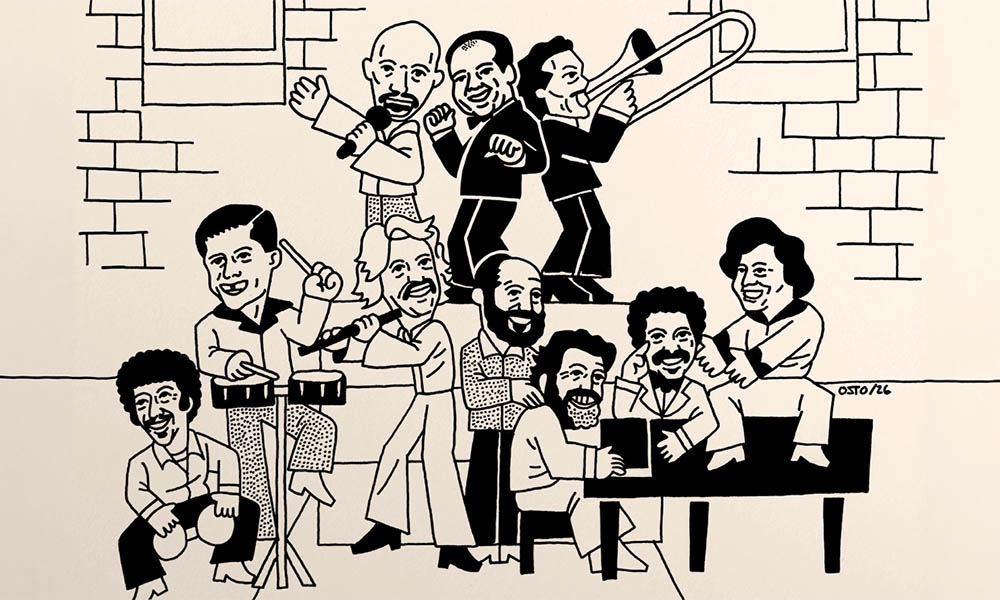
Craft Latino celebrates the label Al Santiago founded in 1956 with a 12-track collection featuring Johnny Pacheco, Charlie and Eddie Palmieri, Pete Rodríguez and the Alegre All Stars.
When Johnny Pacheco played flute in Charlie Palmieri’s band, the two musicians shared a bandstand in New York’s charanga scene. Within a few years, Pacheco was leading a successful charanga of his own, and Palmieri was directing an ensemble that brought them back together. The man behind both ventures was Al Santiago. Seventy years after he founded Alegre Records, Craft Latino revisits those connections on Alegre Records: The Latin Sound of New York (1961–1975), released November 13 on vinyl and digital platforms.
Al Santiago finds his calling
A New Yorker who took over his father’s orchestra before his twentieth birthday, Santiago came to the record business with a bandleader’s ear. He opened a record store and founded Alegre in 1956. One of his earliest successes came in 1960, when he released Johnny Pacheco y Su Charanga, Vol. 1. The young flautist’s feel for mambo found an enthusiastic audience and helped establish the label. His “El Güiro de Macorina” opens the anniversary collection.
The Palmieri brothers follow Pacheco on the record, each with a different idea of what a New York dance band could sound like. On Charlie’s 1973 recording of “La Hija de Lola,” vocalist Vitín Avilés carries the story. Eddie’s “Lázaro y Su Micrófono,” recorded a decade earlier for his second album with La Perfecta, puts the band’s trombones out front. Eddie recorded his first three albums for Alegre, developing a sound that would help shape salsa.

From the boogaloo dance floor to the jazz repertoire
By the mid-1960s, New York musicians were bringing American rhythm and blues into conversation with Afro-Caribbean dance rhythms. Pete Rodríguez’s “I Like It Like That,” which opens the second side of the vinyl edition, became one of boogaloo’s defining hits. Pianist Ricardo Ray and singer Bobby Cruz offer another perspective on the same moment with “Lookie Lookie,” their 1966 single.
Elsewhere, individual voices give the collection much of its character. Chivirico Dávila sings with Orlando Marín’s orchestra on “La Casa,” while Rudy Calzano joins vibraphonist Louie Ramírez on “El Títere.” The closing pair of selections takes listeners from the jazz repertoire to Puerto Rican plena. Roberto Roena and his Megatones reinterpret Paul Desmond’s “Take Five.” Mon Rivera follows with “Monina,” drawing on plena’s role as el periódico cantado, the sung newspaper that turned the events of everyday life into song.
The Alegre All Stars and the road to Fania
Inspired by Panart’s Cuban jam sessions, Santiago formed the Alegre All Stars in 1961. With Charlie Palmieri as musical director, the ensemble drew on a circle that included Pacheco, trombonist Barry Rogers, singer Chamaco Ramírez and timbalero Kako Bastar. “Se Acabó Lo Que Se Daba” and “Tema Alegre” capture the musicians’ playful exchanges. Pacheco later drew on that experience when he formed the Fania All Stars.
Alegre passed to Branston Music in 1966 and to Fania Records in 1975, the year represented here by Ángel Canales’ “Lejos de Ti.” Santiago went on to produce recordings by Celia Cruz, Willie Colón and Mongo Santamaría. The anthology brings his own contribution into focus. He gave musicians room to develop distinctive bands and, in the Alegre All Stars, a place to hear what happened when they played together.
The single-record vinyl edition includes new liner notes in English and Spanish by producer and composer Bobby Marín. Puerto Rican artist Jose Ostolaza, known as Ostomatic, created the hand-drawn cover illustration.
Available for $26.00 (1-LP) on Craft Recordings’ online store.
Tracklist
Side A
- Johnny Pacheco – El Güiro de Macorina
- Charlie Palmieri – La Hija de Lola
- Eddie Palmieri y Su Conjunto La Perfecta – Lázaro y Su Micrófono
- Angel Canales – Lejos de Ti
- Louie Ramirez – El Títere
- Ricardo Ray – Lookie Lookie
Side B
- Pete Rodríguez – I Like It Like That
- Alegre All Stars – Se Acabó Lo Que Se Daba
- Orlando Marín & His Orchestra – La Casa
- Alegre All Stars – Tema Alegre
- Roberto Roena y Sus Megatones – Take Five
- Mon Rivera – Monina

Brazilian mandolin virtuoso Hamilton de Holanda opens a new creative chapter with Nova, a wide-ranging album that brings the traditions of Brazilian instrumental music into conversation with contemporary jazz and sounds from Africa, India, the Caribbean and the Middle East.
Released by Sony Music Brasil on May 20, 2026, the 14-track, 56-minute recording was produced by de Holanda and Marcos Portinari. Recorded in different parts of the world, Nova draws inspiration from the people, places and musical encounters that have marked de Holanda’s extensive travels.
At the heart of the album is the Hamilton de Holanda Trio: de Holanda on 10-string mandolin, Salomão Soares on keyboards and synthesizers, and Thiago “Big” Rabello on drums. Their six-year musical partnership gives the project its central identity, balancing rhythmic precision, melodic freedom and intuitive ensemble interaction.
The trio is joined by an impressive international cast that includes Indian sitarist Anoushka Shankar, French-Lebanese trumpeter Ibrahim Maalouf, Cuban percussionist and vocalist Pedrito Martínez, Angolan singer-songwriter Paulo Flores and Brazilian percussion legend Paulinho da Costa. Other guests include Pedro Martins, Michael Pipoquinha, Pretinho da Serrinha, Mestra Zélia do Prato and Larissa Umaytá.

Opening with “Nova Alvorada,” the album imagines a new dawn rooted in African and Afro-Brazilian traditions. Pedrito Martínez contributes vocals and percussion, Michael Pipoquinha adds electric bass, and singers Tatiana Parra, Vanessa Moreno and Dani Gurgel form the supporting chorus.
Elsewhere, “Som de Baile” channels the energy of Brazilian dance bands, drawing upon the spirit of Banda Black Rio, Jorge Ben Jor and Gilberto Gil. “Frio Lá Fora,” composed during a bitterly cold stay in New York, features Maalouf and Pretinho da Serrinha, while “Pras Crianças” combines an ijexá-based foundation with the resonant sound of Shankar’s sitar. “Luanda (Unidos)” creates a bridge to Angolan semba through the voice and text of Paulo Flores.
Among the album’s most reflective compositions is “Mono no Aware,” which has received an official visualizer. Written by de Holanda and Soares, its title comes from a Japanese expression describing an awareness of life’s impermanence—and the realization that beauty becomes more meaningful because it is temporary.
Recorded at producer and engineer Mario Caldato Jr.’s Los Angeles studio, the piece features Paulinho da Costa on percussion and Pedro Martins on guitar alongside the trio. The gathering connects three generations of Brazilian musicians in a performance that is sophisticated, spacious and emotionally restrained.
The visualizer complements the composition’s contemplative character through imagery evoking delicacy, transition and constant transformation. Rather than presenting a literal storyline, it creates an intimate visual environment in which the music’s mixture of quiet joy and underlying sadness can unfold. The official visualizer is available through Hamilton de Holanda’s YouTube channel.
Now entering his sixth decade, de Holanda remains one of Brazilian instrumental music’s most innovative figures. By expanding the traditional eight-string bandolim into a 10-string instrument, he developed a broader harmonic and melodic vocabulary that has allowed him to move naturally among choro, samba, jazz and global musical traditions.
With Nova, that spirit of invention is guided by gratitude, generosity and an enduring belief in music’s ability to connect people. Tradition and experimentation are not treated as opposites; they become complementary parts of a living musical language.
As de Holanda explains, creating original music with such an extraordinary community of artists is his way of affirming that, regardless of the world’s uncertainties, “the music will continue.”
Nova — Complete Track Listing
1. Nova Alvorada — Hamilton de Holanda
2. Presente pra Sempre — Hamilton de Holanda
3. Nasci — Hamilton de Holanda
4. Som de Baile — Hamilton de Holanda
5. Mono no Aware — Hamilton de Holanda and Salomão Soares
6. Frio Lá Fora — Hamilton de Holanda and Gabriel de Holanda
7. Carrossel — Hamilton de Holanda and Gabriel de Holanda
8. Pras Crianças — Hamilton de Holanda
9. Luanda (Unidos) — Hamilton de Holanda
10. Por Essa Eu Não Esperava — Hamilton de Holanda and Gabriel de Holanda
11. Forrozin de Mestra Zélia — Hamilton de Holanda
12. Choro Fado — Hamilton de Holanda
13. Sol da Noite — Hamilton de Holanda
14. Até Amanhã — Hamilton de Holanda and Salomão Soares
Album Credits
Hamilton de Holanda Trio
Hamilton de Holanda: 10-string mandolin
Salomão Soares: keyboards, synthesizers and Moog
Thiago “Big” Rabello: drums and percussion
Guest Artists and Additional Musicians
“Nova Alvorada”
Pedrito Martínez — percussion and vocals
Michael Pipoquinha — bass
Tatiana Parra — backing vocals
Vanessa Moreno — backing vocals
Dani Gurgel — backing vocals
“Nasci”
Eduardo Neves — tenor saxophone
Aquiles Moraes — trumpet
Rafael Rocha — trombone and horn arrangement
“Som de Baile”
Eduardo Neves — tenor saxophone
Aquiles Moraes — trumpet
Rafael Rocha — trombone and horn arrangement
Larissa Umaytá — percussion
“Mono no Aware”
Paulinho da Costa — percussion
Pedro Martins — guitar
“Frio Lá Fora”
Ibrahim Maalouf — trumpet
Pretinho da Serrinha — percussion
“Pras Crianças”
Anoushka Shankar — sitar
Leander Motta — moringa percussion
“Luanda (Unidos)”
Paulo Flores — voice and spoken text
“Forrozin de Mestra Zélia”
Mestra Zélia do Prato — voice
Production
Producers: Hamilton de Holanda and Marcos Portinari
Executive producer and editing engineer: Marcos Portinari
Assistant producer: Fellipe Cabral
Mixing: Thiago Rabello and Da Pá Virada
Mastering: André Dias
Assistant engineer: Vitor Nery
Photography: Nando Chagas
Label: Sony Music Brasil
Release date: May 20, 2026
Format: Digital album
Duration: Approximately 56 minutes

-

 25 Most Read Posts13 years ago
Juan García-Herreros “Snow Owl” – Normas
-

 25 Most Read Posts15 years ago
Edy Martínez, the Music Architect Behind the Piano
-

 25 Most Read Posts16 years ago
Raphael Cruz Reaffirms His Commitment To Latin Jazz!
-

 25 Most Read Posts11 years ago
Rubén Blades con Roberto Delgado & Orquesta: Son de Panamá