
Concerts
Arturo O’Farrill and the ALJO Present East Meet West featuring John Santos

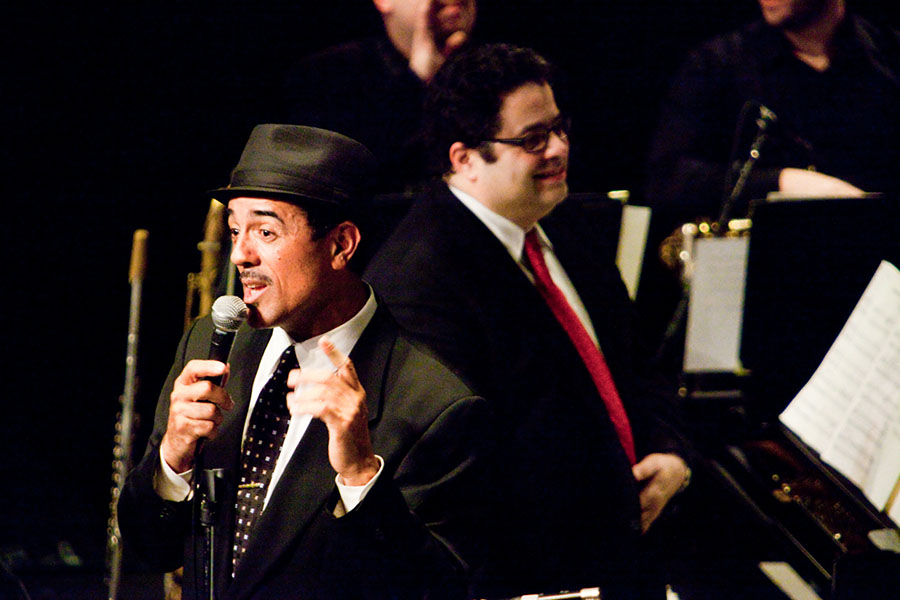
Arturo O’ Farrill and the mighty Afro Latin Jazz Orchestra extended a warm New York welcome to percussionist, composer, historian and educator John Santos, one of the foremost exponents of Afro-Latin music in the world. Santos, who is based in the San Francisco Bay area curated two concerts and headed up a discussion that focused on the unspoken rivalry between East and West Coast Latin jazz.
Simphony Space, New York, February 1st and 2nd, 2013 | Photographs by David Garten
“We don’t define ourselves by what we’re or what we’re not, nor by the opinions of what this music is or is not. We define our music by the possibility of what happens when you relinquish control, carry the pueblo in your soul and leap into the infinite.” – Arturo O’Farrill
The Orchestra paid tribute to their West Coast brethren through the music of West Coast musicians: John Santos, Wayne Wallace, Saul Sierra, Marco Diaz, Ron Stallings, John Calloway and José Rizo. The program took flight with Israel Y Arístides, a danzón dressed up with some rumba and Abakuá inspired by and dedicated to two of the greatest figures in the history of Cuban music – bassist/composer Israel López “Cachao” and tumbador extraordinaire Federico Arístides Soto AKA Tata Güines. Señor Olmos pays tribute to the Mexican actor, Edward James Olmos. The rumba, SF Bay captures the relaxed and progressive sophistication of the San Francisco Bay area. O’ Farrill payed tribute to a fallen colleague with the intricate and somewhat frantic composition titled Day of the Dead. No Te Hundas (Don’t Drown Yourself), a funky Puerto Rican bomba featured sonero Frankie Vasquez and percussionist, dancer Nelson Matthew González, who is a member of Danza Fiesta, a theatrical dance troupe that regularly performs with Los Pleneros de la 21. González’s fancy footwork demonstrated the intricacy and beauty of the bomba and drew a well-earned round of applause.

The Afro-Latin Jazz Orchestra is made up of 18 eminent musicians, many of whom are respected leaders in their own right. It is a cross-generational powerhouse that reveres tradition and relishes in taking musical leaps of faith. With such an abundance of talent it’s difficult to single out a particular moment or person. Nevertheless I enjoyed watching John Santos, who was beaming with pride as he traded licks with percussionist Tony Rosa, bongo player Joe González and drummer Vince Cherico. Veteran saxophonist Bobby Porcelli and trumpeter Jim Seeley gave new meaning to the word “eminent.” It was a treat to see Arturo O’ Farrill play more than less. More often than not he gets caught up leading the band. I have had the pleasure of seeing the Afro Latin Jazz Orchestra perform many times but on this evening they were particularly hot!

Regrettably, I was unable to attend the East Meets West discussion. However, the topic piqued my interest and led me to the following insightful piece by writer and collector, DJ Danny: ‘Latin jazz on the West Coast was something different than it was on the East. It was something that percolated its way down through California’s diffuse network of musicians, attracting its adherents from the Mexican-American and African-American communities, the scattering of Cuban and Puerto Rican percussionists who’d made their way to the Bay Area and Los Angeles for work, and the jazz musicians who’d already established themselves there. Cooler-toned, more studied, and more exotic, it was, very broadly, the work of jazz musicians playing in a Latin style, and sort of the inverse of what had developed organically in the Puerto Rican neighborhoods of New York City, where musicians like Tito Puente and Eddie Palmieri might play Latin jazz without it ever dominating their broader repertoires of mambos, boleros, cha cha’s, etc.’’

According to Arturo O’ Farrill “The East Coast jazz scene has always been positioned as the more important of the two because so many heroes associated with this music forged their careers here.” But he is also quick to point out that “Being first does not mean best or better.”
John Santos believes that “There will of course be folks who get inundated by the local influences and are not exposed to outside stuff, but the music itself usually brings folks to other frontiers sonically if not physically, smashing barriers and preconceptions along the way.”

Here’s my take. Each music scene has its own distinctive sound. The differences between the two are less glaring than they were during the 1950s and 1960s when Cal Tjader, Mongo Santamaría and Willie Bobo ruled in the West and Tito Puente, Tito Rodríguez and Machito ruled in the East. Today the differences can be heard in the music of Poncho Sánchez, Bobby Matos, John Santos, Wayne Wallace, John Calloway and Rebeca Mauleon in the West and Wilson “Chembo” Corniel, Papo Vázquez, Bobby Sanabria, Dafnis Prieto, Yosvany Terry, the González brothers and Steven Kroon in the East.
East Meets West demonstrated that yes, there are differences between East and West Coast Latin jazz however at the end of the day, Swing belongs to everyone! For more programs like this, I urge the reader to contribute to the Afro Latin Jazz Alliance, a non-profit organization that provides a comprehensive array of performance and education programs. ALJA programs celebrate Latino contributions to American jazz and explore the rich diversity of jazz in the Americas. The Alliance is dependent on your support, so please give generously.

For Additional info on the Afro Latin Jazz Alliance visit afrolatinjazz.org
Recommended Recordings
THE DEFINITIVE EAST MEETS WEST RECORDING
Cal Tjader and Eddie Palmieri – El Sonido Nuevo (Verve Records, 1959)
WEST
The John Santos Sextet – Filosofía Caribeña, Vol. 1 (Guataca Music, 2011)
José Rizo’s Jazz on the Latin Side All-Stars – Tambolero (Saungu Records, 2007)
José Rizo’s Mongorama – (Saungu Records, 2011)
Poncho Sánchez – Latin Soul (Concord Picante, 1999)
EAST
Wilson “Chembo” Corniel – Afro Blue Monk (American Showplace Records, 2012)
Papo Vázquez Mighty Pirates and Troubadours – Oasis (Picaro Records, 2012)
Yosvany Terry – Today’s Opinion (Criss Cross, 2012)
Steven Kroon – El Mas Allá (Beyond) (Kroonatune Records, L.L.C., 2008)


On the 22nd of May, The Sound Room on upper Broadway in Oakland, California, presented guitarist Ray Obiedo and his Latin Jazz Group. At the sold out show, Obiedo, ever the congenial host, wasted no time introducing his fine assemblage of musicians; Murray Low (piano), Jeff Cressman (trombone), Dan Feiszli (acoustic bass), Michael Spiro (percussion), Jonathan Bendich (congas) and Phil Hawkins (drums).
Ray’s composition “Criss Cross” was the opening tune, and what a blast the band had with that number. In fact, Bendich played such a swirling complex solo that his body almost left the stage. Bendich’s enthusiasm influenced the rest of the group as they all were really loose after the first tune. The next song, an Obiedo-penned number titled “True Or False”, cooked along in a 6/8 groove with Spiro on the chekere. Obiedo took a break and had Spiro give a brief lesson on one of thousands of songs found in the Afro-Cuban tradition associated with the spiritual belief system, Santería.
“Santa Lucia” was the last song in the set where Cressman and Low soloed with great feeling.

The second set opened with Milton Nascimento’s “Veracruz”, a lively samba from Brazil featuring stellar contributions from the bass and drum duo of Feiszli and Hawkins. Cressman’s muted trombone drove the groove on “Cubo Azul”, from Obiedo’s album Latin Jazz Project Vol. 1. Obiedo quite often finds room for the continuing explorations of that good old East Bay Funk. During “Cubo Azul” the band shifted gears and rode the Funk wagon aided by Spiro’s inventive timbales. To cap off the evening the classic Sonny Rollins Calypso “Saint Thomas” proved to be a perfect choice. The band tore into the tune with their collective musical prowess, not knowing that three days later Rollins would die at the age of 95. An unwittingly beautiful tribute to a jazz master.
Once again Obiedo and company lifted our spirits on that cool May night. Spiro gave the group a boost with his encyclopedic knowledge of Afro-Cuban and Brazilian rhythms, Cressman impressed on soaring trombone, Low graced the music with carefully placed notes, Bendich got quite inspired rocking back and forth to the beat, Feiszli and Hawkins maintained their patented solid underpinning, and Obiedo held the whole thing together, choosing his notes carefully and masterfully. A memorable evening of music indeed!!


On April 25, 2026, Koerner Hall became the site of something far greater than a conventional jazz performance. Presented by The Royal Conservatory of Music, the evening brought together pianist-composer Danilo Pérez, bassist John Patitucci, and drummer Brian Blade—three master improvisers whose profound musical relationship was forged during their two-decade tenure in Wayne Shorter’s legendary quartet.
The first half of the concert reaffirmed why this trio remains one of the most compelling small ensembles in contemporary jazz. The second half expanded that intimacy into something far more ambitious: the Canadian premiere of Pérez’s The Panáfrica Suite: Echoes from the Isthmus. Structured in three movements, this sweeping, large-scale work honoured Afro-Panamanian history while drawing powerful connections to the broader African diaspora across the Americas. By the evening’s end, the audience had witnessed not merely a concert but a profound artistic statement on history, resistance, survival, and cultural transformation.

From the opening notes of “Panamá Libre,” Pérez immediately established the deeply personal undercurrent running through the evening. Written during the aftermath of the United States invasion of Panamá on December 20, 1989, the composition carried both political urgency and emotional vulnerability. The composition felt especially poignant coming from an artist whose music has consistently engaged questions of identity, justice, and belonging.
The emotional heart of the trio set came with “Beloved,” dedicated to Nobel Prize-winning author Toni Morrison. Pérez delivered the piece with remarkable sensitivity, letting each note breathe and resonate with quiet emotion. The performance reflected themes often found in Morrison’s work—memory, suffering, resilience, and generational pain—while remaining deeply moving without feeling overly dramatic.

That same spirit of political engagement continued with “Alternate Realities,” dedicated to activist, scholar, and cultural icon Angela Davis. The piece felt bold and restless, with unexpected twists that created a sense of tension and unpredictability. Pérez moved between intense bursts of energy and quieter reflective moments, while John Patitucci provided powerful support with his dynamic bass playing. Brian Blade added surprising rhythmic textures that kept the performance constantly evolving, pushing Pérez toward daring and expressive improvisations.
The trio closed with Wayne Shorter’s haunting “Miyako,” and the emotional significance of that choice was impossible to ignore. Shorter’s spirit remains deeply embedded in this ensemble’s DNA. Rather than treating the composition as a nostalgic homage, Pérez, Patitucci, and Blade approached it as an evolving conversation with their late mentor—one rooted in tenderness, openness, and discovery. For longtime followers of Shorter’s quartet, this performance felt especially moving.
Patitucci and Blade remain extraordinary collaborators because they listen as deeply as they perform. Patitucci’s bass work was consistently elegant yet commanding, shifting seamlessly between melodic counterpoint and foundational groove. Blade, as always, played with remarkable sensitivity—often suggesting rhythm rather than asserting it outright. His ability to move from whisper-soft cymbal textures to thunderous eruptions remains unmatched.

After intermission, the concert transformed dramatically in scale and scope. The stage was filled with a Toronto-based big band featuring Canadian jazz icon Jane Bunnett, award-winning vocalist April May Webb, and members of the Berklee Global Jazz Institute for the Canadian premiere of Pérez’s The Panáfrica Suite: Echoes from the Isthmus, co-commissioned by the Royal Conservatory of Music.
This ambitious work explores the enduring African presence in Panamá and throughout the Americas, as well as the complex relationship between Panamá and the United States of America, centring stories that are often marginalized in official historical narratives. Pérez has described the suite as an effort to honour Afro-Panamanian heritage and celebrate “the living spirit of Africa in the Americas.” That intention resonated deeply throughout the performance.

Movement I: Afro-Panamanian Roots opened with “Bayano’s Landing,” invoking the memory of Bayano, the legendary African leader who resisted Spanish colonial forces after escaping enslavement in 16th-century Panamá. The music felt ceremonial, almost ritualistic. Dense Afro-Panamanian percussion, layered brass harmonies, and Pérez’s commanding piano work created an atmosphere of ancestral remembrance.
“Cimarrón Spirit” followed with explosive energy. Here, Pérez honoured maroon communities whose resistance shaped Afro-Panamanian identity. The arrangement surged with rhythmic complexity and dramatic ensemble interplay.

Movement II: Echoes of the Canal shifted toward the complex history of migration and labour associated with the construction of the Panamá Canal.
In “Between Two Worlds,” Pérez explored cultural hybridity through shifting rhythmic frameworks that mirrored displacement and cultural convergence. African, Caribbean, Panamanian, and jazz traditions collided and intertwined with remarkable sophistication.
“Wonder of the World” reflected both the scale of the Panamá Canal’s engineering achievement and the immense human sacrifice behind its construction. Webb delivered a stunning vocal performance here—deeply expressive, spiritually grounded, and emotionally raw.
Bunnett’s soprano saxophone work proved especially electrifying—piercing, soulful, and emotionally fearless. Her improvisation served as both narrative voice and emotional catalyst.

Movement III: Panamá brought the suite toward reflection and transcendence.
“Echoes of the Isthmus” felt almost prayerful, as though generations of ancestral voices were speaking through the music.
The closing composition, “Panamá: Land of the Butterflies,” delivered a breathtaking finale rooted in transformation and renewal. The full ensemble played with exhilarating force, building toward a triumphant ending that felt both celebratory and deeply earned.
Pérez invited the audience to sing along during the closing communal piece:
“Ola, ola, ola de la mar,
mi santa se está quemando
por falta de agua.”
Which translates as:
“Wave, wave, wave of the sea,
my saint is burning
for lack of water.”
“Ola” literally means “wave” (as in an ocean wave)
“mi santa” literally translates as “my saint,” though depending on cultural/religious context (especially Afro-Caribbean or folkloric traditions), it could carry deeper spiritual meaning.

What makes Pérez such a singular artist is his ability to merge virtuosity with vision. His compositions are never merely technical achievements—they function as vehicles for cultural preservation, political reflection, and human connection. Throughout the evening, Patitucci and Blade remained indispensable partners, while Bunnett and Webb added distinct layers of emotional and artistic depth.
At a time when conversations about migration, colonial history, race, and identity continue to shape global discourse, The Panáfrica Suite: Echoes from the Isthmus felt profoundly urgent. More importantly, it felt necessary.
At Koerner Hall, Danilo Pérez transformed history into sound—and in doing so, reminded us that jazz remains one of the most powerful vehicles for memory, truth-telling, and collective healing.


Béla Fleck, Edmar Castañeda & Antonio Sánchez: BEATrio
Something about trios demands a certain synchronicity for the format to fire as one. The players, regardless of instrumentation, must possess it — that elusive it. A simpatico where three become one, as if communication turns subliminal, each member knowing intuitively where the others are headed.
And so it was that three unlikely instruments — harp, banjo, and drums — united as one in the outstanding BEATrio.
The concert flowed from beginning to end. The trio played many songs from their self-titled 2025 album. Audience interaction was kept to a warm minimum: entering the stage to resounding applause that drew a nod and a smile from Béla Fleck, the trio took their spots and proceeded to perform with extreme dynamism, spontaneity, and that simpatico mentioned above.

After three songs — though it was hard to distinguish one from the next, the flow was so flawless — Antonio Sánchez stepped to the microphone. He made introductions and shared some engaging stories: working with Béla as a duo, and having worked with Edmar in the Paquito D’Rivera big band. The trio coming together was Béla’s idea.
Yes, it was Béla who came up with the concept. Antonio thought it was a crazy combination — but he loved it and wanted to go for it. The three gathered in the studio, had fun, made some magic, and Bela, Edmar, Antonio, Trio — BEATrio — was born.
Here they were, Antonio told us, on the second-to-last gig of their North American tour. He went on to name the songs performed: “Archipelago,” “Pellucidar,” and “Kaleidoscopes” — each one a showcase for the constant percussive energy driven by Antonio’s remarkable prowess.

Edmar Castañeda was next to take the microphone. He wanted to know how many Colombians were in the audience. A couple called out. “Two Colombians — that’s the most on the tour.” He then spoke about the next tune, born of a dark period in his life: surgery on his hand, worry about everything — but faith — and a hand now better than ever. The song: “Whispers of Resilience.”
Béla spoke last, clearly delighted with himself for writing what he called a tango — so proud, in fact, he could barely contain it. He brought it to Edmar, who declared it a cha-cha. When Antonio heard it, he said: “That’s a danzón.” And so it became “Cloak and Dagger.”
That highlight, “Cloak and Dagger” — which to my ears sounded like a samba-reggae tune — was followed by a beautiful Béla solo that conjured the sweeping romanticism of Gershwin’s “Rhapsody in Blue.”

The group closed with a piece that brought to mind dueling banjos — or rather, dueling strings — Béla coaxing the banjo through the full registers of multiple string instruments while Edmar wailed, slapped, and bent the harp into a sonic orchestral kaleidoscope.
The band received a rousing standing ovation and, in short order, returned for one final dynamic performance — the strings, dueling once again, with drumming that seemed to arrive from another world entirely.
An out-of-this-world experience: harp, banjo, and drums — who would have thought it could work?
Bravo, BEATrio!

-

 25 Most Read Posts13 years ago
Juan García-Herreros “Snow Owl” – Normas
-

 25 Most Read Posts14 years ago
Edy Martínez, the Music Architect Behind the Piano
-

 25 Most Read Posts16 years ago
Raphael Cruz Reaffirms His Commitment To Latin Jazz!
-

 25 Most Read Posts11 years ago
Rubén Blades con Roberto Delgado & Orquesta: Son de Panamá